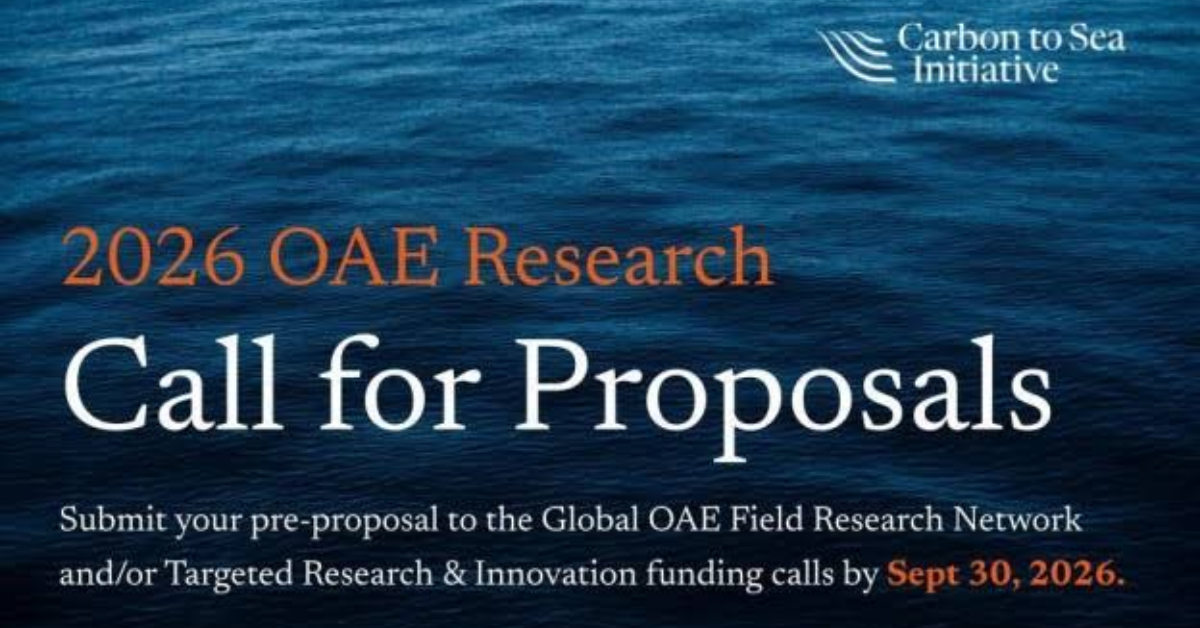
The Carbon to Sea Initiative has opened its 2026 Ocean Alkalinity Enhancement (OAE) Research Call for Proposals, offering major funding to organizations and research teams advancing the scientific, technical, and social understanding of ocean alkalinity enhancement as a potential climate mitigation solution.
The 2026 funding call is divided into two major programmes: the Global OAE Field Research Network and Targeted Research & Innovation.
Carbon to Sea intends to fund a portfolio of awards totaling up to USD 5 million through the Global OAE Field Research Network and another up to USD 1 million through Targeted Research & Innovation.
This means up to USD 6 million in total portfolio funding is available across the two calls.
Researchers, universities, scientific organizations, research institutions, and development teams working on ocean science, carbon dioxide removal, environmental impacts, alkalinity production, marine chemistry and related fields may find the opportunity particularly relevant.
Interested applicants must submit a pre-proposal by September 30, 2026.
Carbon to Sea OAE Research Grants 2026: Key Details
Funder: Carbon to Sea Initiative
Programme: 2026 OAE Research Call for Proposals
Research Area: Ocean Alkalinity Enhancement
Purpose: Advance scientific, technical, and social understanding of OAE
Number of Open Calls: Two
Global OAE Field Research Network Funding: Up to USD 5 million total
Targeted Research & Innovation Funding: Up to USD 1 million total
Combined Portfolio Funding: Up to USD 6 million
Pre-Proposals Opened: August 11, 2026
Pre-Proposal Deadline: September 30, 2026
Stage 2 Invitations: October 23, 2026
Full Proposal Deadline: December 15, 2026
Expected Award Decisions: February 2027
Applicants should note that the USD 5 million and USD 1 million figures refer to the total funding available across portfolios of awards, not the amount automatically available to each successful applicant.
What Is Ocean Alkalinity Enhancement?
Ocean alkalinity enhancement is an emerging approach to carbon dioxide removal (CDR).
It aims to work with natural ocean chemistry to increase the ocean’s ability to store carbon.
The ocean already plays an enormous role in the global carbon cycle.
Research into OAE examines whether carefully increasing ocean alkalinity could enhance carbon dioxide removal while storing carbon in stable forms.
However, substantial scientific questions need to be answered before OAE could potentially be deployed responsibly at larger scales.
These questions include environmental impacts, measurement, carbon-removal verification, deployment methods, cost, scalability and interactions with marine ecosystems.
Carbon to Sea’s research programme is designed to help strengthen this evidence base.
Why Carbon to Sea Is Funding OAE Research
Carbon to Sea has supported research designed to test the scientific foundations of ocean alkalinity enhancement.
Previous work has included laboratory research, mesocosm studies, small-scale trials and modelling of OAE’s potential global impact.
The 2026 research programme moves further toward an important question:
Can OAE be measured, verified and potentially scaled responsibly in real-world conditions?
Answering this requires field evidence alongside targeted scientific and technological research.
The 2026 call therefore separates funding into two complementary areas.
Open Call 1: Global OAE Field Research Network
The largest funding opportunity is the Global OAE Field Research Network.
Carbon to Sea intends to support a portfolio of awards totaling up to:
USD 5,000,000
The programme is designed to support the exploration, development, operation and coordination of field research sites studying OAE.
Global participation is invited.
The goal is to develop research sites capable of helping scientists understand environmental impacts, carbon-removal efficacy, measurement, deployment methods and long-term cost trajectories.
Four Grant Types Under the Global Field Research Network
The first open call contains four grant categories:
1A. Field Site Exploration
This category supports exploration related to potential OAE research sites.
It may be particularly relevant where organizations have identified promising locations but need additional work to determine whether those locations could support rigorous OAE field research.
1B. Field Site Development
This grant category moves further toward establishing and developing field-research capacity.
Projects may help build the scientific, operational and technical foundations required for sustained research at a particular location.
1C. Field Research
This category supports research conducted through OAE field sites.
Field research is particularly important because it allows scientists to examine whether results demonstrated in laboratories or controlled environments translate effectively into real-world marine conditions.
1D. Network Participation
The fourth grant type focuses on participation and coordination within the wider Global OAE Field Research Network.
Developing a shared research network can allow researchers to compare results, strengthen methodologies and create a broader evidence base across different environments.
What Makes a Strong Field Research Site?
Carbon to Sea emphasizes a long-term approach.
The Global OAE Field Research Network is particularly suitable for organizations that have a long-term vision for field science or development in a specific location.
Proposed sites should ideally be capable of supporting sustained, multi-year research rather than a single isolated experiment.
Over time, a field site should have the potential to become a shared resource that can support multiple research teams or studies.
This could allow evidence to accumulate rather than requiring each research project to build a completely new field-testing environment.
The sites should also enable researchers to test laboratory and mesocosm findings under representative real-world conditions.
What Could Field Research Investigate?
Research within the network could help answer questions involving:
- Environmental impacts of OAE
- Carbon-removal efficacy
- OAE deployment methods
- Monitoring
- Measurement
- Verification
- Marine chemistry
- Ecosystem responses
- Sector-specific demonstrations
- Cost trajectories
- Scalability
A central objective is to create stronger evidence about what happens when OAE moves from controlled scientific environments into real marine systems.
Open Call 2: Targeted Research & Innovation
The second funding programme is Targeted Research & Innovation.
Carbon to Sea intends to provide up to:
USD 1,000,000 in total portfolio funding
This call differs from the Global Field Research Network.
Rather than establishing long-term field infrastructure, it is intended for research and development teams proposing short-term, focused projects addressing specific scientific or technological questions.
Two grant categories are available.
2A. Sediment Additionality
The first Targeted Research & Innovation priority examines sediment additionality.
It focuses on understanding how OAE interacts with natural sediment-related alkalinity fluxes.
This issue matters because researchers need to determine how much additional carbon removal can genuinely be attributed to an OAE intervention.
Natural marine processes already influence alkalinity.
If researchers are going to quantify the climate benefit of an OAE intervention accurately, they need methods capable of distinguishing intervention-related changes from naturally occurring processes.
Research under this category can therefore contribute to stronger approaches to carbon-removal accounting and verification.
2B. Alkalinity Innovation
The second targeted category focuses on Alkalinity Innovation.
Projects should explore technologies or methods that could improve the production or performance of alkalinity sources.
This could potentially contribute to reducing costs, improving efficiency and addressing technical barriers that could affect future OAE development.
Innovation in alkalinity sourcing and production is particularly important because even if OAE proves scientifically effective, its broader feasibility will also depend on how alkalinity can be produced and supplied responsibly.
Who Should Consider Targeted Research & Innovation?
This programme is particularly suitable for research and development teams with a clearly defined scientific question or technological challenge.
Strong projects are expected to have a focused research or development plan addressing a specific hypothesis or key research question.
Research could take place in environments including:
- Laboratories
- Mesocosms
- Discrete field trials
Complementary modelling work can also fall within the programme’s scope.
Importantly, fieldwork is not mandatory for the Targeted Research & Innovation grants.
This distinguishes the programme from the Global OAE Field Research Network.
Who Should Consider Applying?
The Carbon to Sea OAE Research Grants 2026 could be relevant to interdisciplinary teams working across areas such as:
Oceanography
Researchers studying ocean systems, marine chemistry and physical or biological ocean processes may have particularly relevant expertise.
Marine Biogeochemistry
Understanding carbon, alkalinity and nutrient cycling is central to evaluating OAE.
Carbon Dioxide Removal
Researchers working on CDR technologies, measurement and verification could contribute directly to the programme.
Marine Ecology
Environmental safety requires understanding how interventions may affect marine organisms and ecosystems.
Geochemistry
Geochemical processes are important for understanding alkalinity sources and interactions between water, sediments and minerals.
Environmental Engineering
Engineers may contribute technologies for producing, processing, transporting or deploying alkalinity.
Climate Science
Climate researchers can help connect OAE interventions with broader carbon-removal and mitigation strategies.
Technology Development
Research and development teams developing new approaches to alkalinity production may find the Alkalinity Innovation category especially relevant.
Global Participation
One important feature of the call is its emphasis on global participation, particularly for the Global OAE Field Research Network.
Oceans differ substantially across locations.
Temperature, circulation, ecosystems, sediment conditions, coastal environments and human activities can all influence research outcomes.
A geographically diverse field-research network can therefore help scientists determine whether OAE behaves differently across environmental settings.
Organizations considering an application should explain why their proposed location provides scientific value.
Two-Stage Application Process
Carbon to Sea uses a two-stage application process.
Applicants should first submit a pre-proposal.
The pre-proposal deadline is:
September 30, 2026
Carbon to Sea will review submissions and invite selected applicants to proceed to Stage 2.
Stage 2 invitations are expected to be communicated on:
October 23, 2026
Only invited applicants will proceed to the full-proposal stage.
The deadline for full proposals is:
December 15, 2026
Funding decisions are expected in:
February 2027
Carbon to Sea notes that programme dates are subject to change.
Preparing a Strong Pre-Proposal
Applicants should first determine which of the six grant types most closely matches their project.
A field-site proposal should not be forced into Targeted Research & Innovation simply because both programmes concern OAE.
Likewise, a short laboratory experiment may be better suited to the targeted call than the long-term field-network programme.
A strong proposal should clearly establish:
The Research Problem
Explain what scientific or technical uncertainty the project addresses.
Why the Question Matters
Connect the project to OAE safety, efficacy, measurability, scalability or cost.
Methodology
Explain how the research will generate credible evidence.
Research Team
Demonstrate that the team has appropriate scientific and technical expertise.
Expected Outcomes
Describe what new evidence, technology, methodology or capability the project could produce.
Relevance to OAE
Make the connection with ocean alkalinity enhancement explicit.
Field Network vs Targeted Research: Which Should You Choose?
Applicants developing a multi-year field research location should primarily examine the Global OAE Field Research Network.
This programme is designed around sustained research sites capable of supporting multiple studies.
Researchers with a specific short-term scientific hypothesis or technical innovation should consider Targeted Research & Innovation.
The targeted programme may be particularly appropriate for controlled experiments, laboratory research, mesocosm studies, modelling or discrete field trials.
Choosing the correct call is important because each programme addresses a different stage of OAE research and development.
Key Application Documents
Carbon to Sea provides several documents for prospective applicants, including:
- Global OAE Field Research Network RFP
- Targeted Research & Innovation RFP
- Application Guidance
- Frequently Asked Questions
- Terms and Conditions
Applicants should review all relevant documents before submitting a pre-proposal.
The call has also been made available in several languages, including French, Spanish, Portuguese, Arabic, Bahasa Indonesia and Chinese, which can help broaden international participation.
Why OAE Research Matters
Carbon dioxide removal is increasingly discussed alongside emissions reductions as part of global efforts to address climate change.
However, emerging CDR technologies require rigorous evidence before they can be considered safe, effective and scalable.
For OAE, major questions remain.
Researchers need to understand whether carbon removal can be accurately measured, whether environmental impacts remain acceptable, how deployment should occur and whether the technology could operate at meaningful scales.
Independent scientific research is therefore crucial.
The Carbon to Sea grants aim to build evidence before large-scale assumptions are made about OAE’s potential.
Important Funding Clarification
Applicants and publishers should be careful when describing the size of this funding opportunity.
Carbon to Sea states that it intends to fund a portfolio of awards totaling up to USD 5 million under the Global OAE Field Research Network.
It separately intends to fund a portfolio totaling up to USD 1 million under Targeted Research & Innovation.
Therefore, describing the opportunity as offering “up to USD 6 million in total funding” across the two programmes is reasonable.
However, it would be misleading to claim that an individual researcher can automatically receive a USD 6 million grant.
Applicants should consult the individual RFP documents for grant-size guidance applicable to their selected category.
Important Dates
The 2026 application timeline is:
August 11, 2026: Pre-proposal submissions open
September 30, 2026: Pre-proposal deadline
October 23, 2026: Stage 2 invitations communicated
December 15, 2026: Full proposal deadline
February 2027: Award decisions expected
Applicants should remember that these dates are subject to change.
Final Thoughts
The Carbon to Sea OAE Research Grants 2026 represent a major funding opportunity for researchers and organizations working at the intersection of ocean science, climate mitigation, carbon dioxide removal and technological innovation.
Two open calls are available.
The Global OAE Field Research Network provides up to USD 5 million in total portfolio funding across four grant types: Field Site Exploration, Field Site Development, Field Research and Network Participation.
The Targeted Research & Innovation call provides up to USD 1 million in total portfolio funding and focuses on Sediment Additionality and Alkalinity Innovation.
Together, Carbon to Sea intends to make available portfolios totaling up to USD 6 million.
The immediate deadline applicants need to know is September 30, 2026, when pre-proposals must be submitted.
Selected applicants are expected to receive invitations to the second stage in October, with full proposals due in December and award decisions anticipated in February 2027.
Research teams interested in applying should carefully review the relevant RFP, application guidance, FAQs and terms and conditions before preparing their submission.
SEO Keywords: Carbon to Sea OAE Research Grants 2026, Carbon to Sea Research Grants 2026, Ocean Alkalinity Enhancement Grants 2026, OAE Research Funding 2026, Carbon to Sea Initiative Funding, Carbon Removal Research Grants 2026, Carbon Dioxide Removal Grants, CDR Research Funding 2026, Ocean Research Grants 2026, Climate Research Grants 2026, USD 6 Million Research Funding, Global OAE Field Research Network, OAE Field Research Grants, Field Site Exploration Grant, Field Site Development Grant, OAE Field Research Funding, Targeted Research and Innovation Grant, Sediment Additionality Research, Alkalinity Innovation Grants, Marine Science Research Grants, Oceanography Research Funding 2026, Marine Biogeochemistry Grants, Climate Technology Grants 2026, Green Technology Research Funding, Carbon Capture Research Grants, Ocean Carbon Removal Research, Environmental Research Grants 2026, Global Research Grants 2026, Climate Mitigation Research Funding, Carbon to Sea Call for Proposals 2026, OAE Call for Proposals, Research Grants Deadline September 2026, Carbon Removal Innovation Funding, Marine Research Funding Opportunities, Climate Science Funding Opportunities 2026
Also Check
IOC Olympic Studies Centre Research Grant 2027: Up to USD 6,000 for PhD Students & Early Career Academics
Work Remotely on Africa’s Industrial Future: DSI/NRF SARChI Offers Up to $15,000 for 3 Research Commissions in 2026 (Fully Funded)
PILnet Is Hiring a Program Consultant (East Africa) | Remote NGO Consultancy | USD 1,300–1,600/Month
Follow Us On Our Social Media Platforms
WhatsApp Group:
https://chat.whatsapp.com/CculATjfuTNKDISQGtP0uw?s=cl&p=a&mlu=4&ilr=4
WhatsApp Channel:
https://whatsapp.com/channel/0029Vb7isAg6buMKEWUmte0K
Facebook Page:
