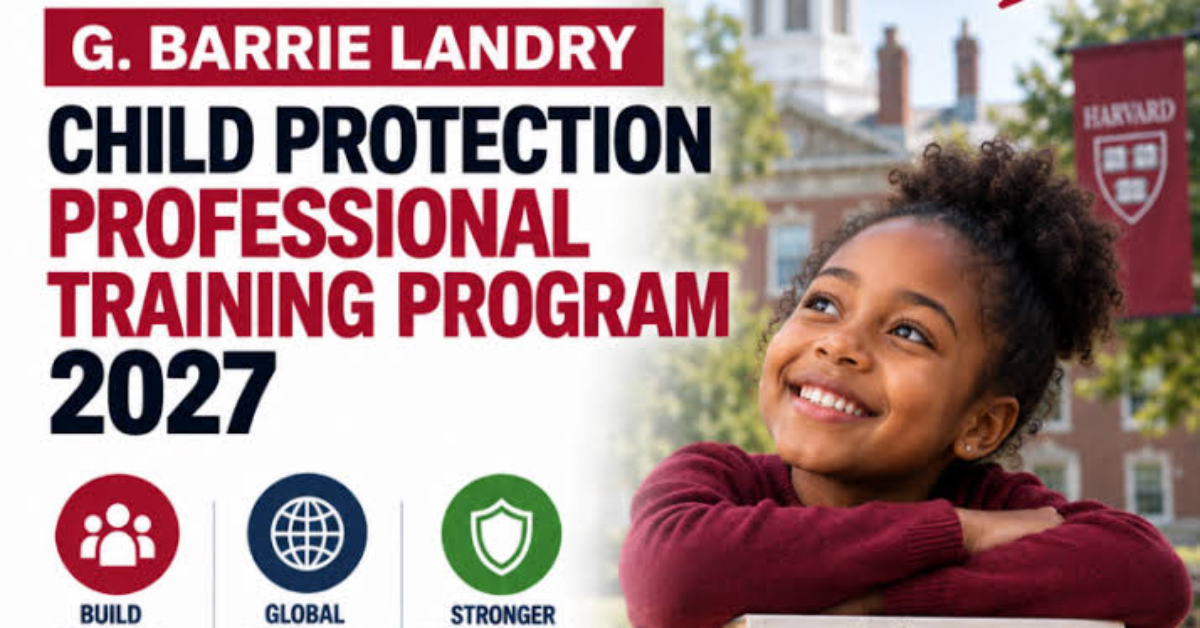
Applications are now open for the 2027 G. Barrie Landry Child Protection Professional Training Program, an intensive professional development opportunity delivered by the FXB Center for Health & Human Rights at Harvard University.
The one-week, in-person program is designed for mid-career professionals working in child protection across government agencies, international organizations, and local NGOs. Participants receive specialized training from Harvard faculty and child protection experts while developing practical solutions to child protection challenges in their countries.
The 2027 program will take place during the week of June 7, 2027, at the Harvard T.H. Chan School of Public Health campus in Boston, Massachusetts. Applications are currently open.
About the Harvard G. Barrie Landry Child Protection Training Program
The G. Barrie Landry Child Protection Professional Training Program, also known as Landry CP Training, is a one-week intensive course for experienced professionals whose work involves protecting children from abuse, exploitation, violence, and neglect.
Participants may work within government, international organizations, or local nongovernmental organizations.
The program recognizes that child protection challenges differ considerably between countries and communities. Children may face challenges associated with displacement, labor, abuse, neglect, early marriage and other circumstances.
The training therefore emphasizes an integrated and multi-sectoral approach to child protection, bringing together different institutions and professionals to strengthen protection systems.
What Participants Will Learn
The training is designed to strengthen both technical knowledge and professional leadership.
Harvard faculty members with relevant child protection expertise teach participants throughout the program.
One of the main objectives is helping professionals understand how violence, exploitation and abuse can affect children’s emotional, intellectual and social development.
Participants also explore the effects of conflict, natural disasters and other traumatic experiences on children.
The program introduces multidisciplinary approaches, analytical frameworks and international human rights principles that can be used to prevent and respond to harms affecting children.
Leadership and Child Protection Systems
The course goes beyond understanding individual child protection problems.
Participants examine the components necessary for building a well-functioning national child protection system.
The training explores data sources used within child protection systems, challenges associated with establishing effective systems, and techniques for evidence-based advocacy.
Digital solutions and their potential role in addressing child protection challenges are also covered.
Participants additionally develop coalition-building, negotiation, and leadership skills that can help them advocate for policy and legislative reforms across areas including:
- Education
- Health
- Social services
- Justice
The ultimate objective is to help participating teams identify practical options for strengthening child protection systems within their respective countries.
Who Can Apply?
The Harvard training program targets mid-career professionals working in areas where child protection is critical.
Applicants should be committed to developing multi-sectoral leadership capabilities that can increase the impact of their work.
However, there is an important application requirement prospective participants need to understand:
Individuals cannot apply independently.
Applications must be submitted as a cross-sectoral country team consisting of three people.
Required Country Team
Harvard states that the preferred country team consists of:
One government representative – A professional employed by a government agency.
One international organization representative – A professional working for an international organization.
One local NGO representative – A professional employed by a local nongovernmental organization.
This structure reflects the program’s emphasis on developing national capacity through cooperation between institutions involved in child protection.
Applications submitted by individuals will not be considered for admission.
English Language Requirement
Participants must be fluent in both written and spoken English.
Applications are reviewed by the child protection teaching and training team at Harvard’s FXB Center for Health & Human Rights.
Successful country teams will be informed before the program begins.
Harvard Child Protection Training Curriculum
The program is divided thematically, with complementary learning activities delivered throughout the training week.
Previous course sessions have included topics such as:
Protecting the Developing Brain: Understanding how violence, abuse and neglect affect children’s development.
Social Service Workforce: Exploring approaches to engaging and strengthening professionals responsible for providing social services.
Climate Change and Disasters: Examining connections between environmental challenges, disasters and children’s well-being.
Negotiation: Developing negotiation skills relevant to building effective child protection systems.
Child Protection in a Digital World: Exploring child protection challenges and opportunities associated with digital environments.
Measurement and Evidence: Understanding how evidence and data can strengthen child protection systems.
Social and Structural Inequalities: Examining how inequalities affect children’s health and well-being.
Participants Work on a Real Child Protection Challenge
A major feature of the Landry Child Protection Training Program is its practical approach.
Before traveling to Harvard, each participating country team collaboratively develops a case study based on a real child protection challenge it is currently addressing.
The team presents this case study at the beginning of the training.
The presentation identifies the child protection problem and potential solutions the participants would like to develop.
Training organizers provide materials to help participating teams prepare their case studies before attending Harvard.
Examples of Child Protection Challenges
Previous country teams have worked on issues including:
- Child marriage
- Alternative care
- Violence against children
- Inadequate child protection laws
- Shortages within the social service workforce
- Lack of reliable administrative child protection data
Teams continue developing their case studies throughout the Harvard training week.
They use research, concepts and discussions from the course to refine their proposed approaches.
Final Presentation at Harvard
On the final day, each country team presents the lessons it has learned and explains how those lessons could be applied to the child protection issue identified in its case study.
The presentation is delivered to a panel of Harvard-affiliated child protection experts.
Teams then receive individualized feedback and recommendations from the panel.
This structure helps participants move from theoretical learning toward practical strategies that can potentially be implemented after returning to their professional environments.
Is the Harvard Child Protection Program Fully Funded?
The program provides significant financial support, but it should not be described simply as fully funded.
Thanks to support from the G. Barrie Landry Fund for Child Protection Professional Training and UNICEF USA, tuition costs are covered for admitted participants.
However, participants are normally responsible for their:
Travel costs
Accommodation costs
Visa expenses
Other required travel documentation
Harvard notes that admitted participants may have an opportunity to apply for some travel and/or accommodation funding after admission.
Therefore, applicants should not assume that flights and accommodation will automatically be paid.
How Many Participants Will Be Selected?
Enrollment is limited to 30 participants.
Because applications are made through three-person country teams, this corresponds to:
10 country teams × 3 professionals = 30 participants
The limited cohort allows participants to work closely with instructors, experts and professionals representing other countries.
Where Will the 2027 Training Take Place?
The 2027 program will be conducted in person at the Harvard T.H. Chan School of Public Health campus in Boston, Massachusetts, United States.
The training is led by Harvard University’s FXB Center for Health & Human Rights and taught by Harvard faculty alongside expert child protection professionals.
2027 Program Date
The 2027 G. Barrie Landry Child Protection Professional Training Program will take place during the week of June 7, 2027.
Prospective applicants should factor the in-person program dates into their professional schedules before applying.
How to Apply for the Harvard G. Barrie Landry Program 2027
Applications for the 2027 program are now open.
Unlike opportunities with a standard public application portal, prospective teams are instructed to request an application from the program.
Applicants can contact Rebecca Shin, Director of the Child Protection Program, using the email address provided by Harvard.
Teams can also use this contact for questions concerning the program or application process.
Application Checklist
Before requesting the application, potential participants should confirm that they meet the core requirements.
Applicants should:
- Be mid-career professionals working in child protection or an area where child protection is critical.
- Form a three-person cross-sectoral country team.
- Ideally include representatives from government, an international organization and a local NGO.
- Be fluent in written and spoken English.
- Be available to participate in the in-person training in Boston.
- Be prepared to collaboratively develop a real-world child protection case study.
- Consider travel, accommodation and visa requirements before participating.
Individual applications are not accepted.
Why This Harvard Training Opportunity Stands Out
One of the program’s most distinctive features is its cross-sectoral team approach.
Instead of training individual professionals independently, Harvard brings together professionals representing institutions that may need to cooperate when addressing child protection challenges nationally.
The curriculum also combines academic knowledge with leadership, negotiation, evidence-based advocacy and practical problem-solving.
Country teams leave the program having developed approaches specifically connected to child protection challenges within their own contexts.
Key Details at a Glance
Program: G. Barrie Landry Child Protection Professional Training Program 2027
Institution: FXB Center for Health & Human Rights at Harvard University
Location: Boston, Massachusetts, USA
Format: In-person
Duration: One week
2027 Dates: Week of June 7, 2027
Target Group: Mid-career child protection professionals
Application Type: Three-person cross-sectoral country teams
Preferred Team: Government + international organization + local NGO representatives
Cohort Size: 30 participants / 10 country teams
Tuition: Covered for admitted participants
Travel and Accommodation: Generally the participant’s responsibility; some funding may potentially become available after admission
Language: Written and spoken English fluency required
Application Status: Open
Final Thoughts
The Harvard G. Barrie Landry Child Protection Professional Training Program 2027 offers experienced child protection professionals an opportunity to strengthen their technical, leadership, and negotiation capabilities through an intensive week of training at Harvard.
The program is particularly valuable for professionals seeking to improve national child protection systems through cooperation between governments, international organizations and civil society.
With tuition covered for admitted participants and enrollment limited to 30 professionals across ten country teams, interested organizations should begin identifying potential team members early.
The program takes place during the week of June 7, 2027, in Boston, and applications are currently open.
Prospective applicants should remember that applications must be submitted by three-person country teams rather than individuals and that travel, accommodation, and visa expenses are not automatically covered.
SEO Keywords: Harvard G Barrie Landry Child Protection Training 2027, Harvard child protection program 2027, Harvard professional training 2027, Harvard training programs for international professionals, child protection training USA, Harvard FXB Center training, G Barrie Landry Program 2027, child protection professional development, Harvard international training opportunities, UNICEF child protection training, Harvard tuition covered program, child protection leadership training, Harvard programs 2027
Also Check
United Nations Ocean Affairs Fellowship 2027: Fully Funded Opportunity for Ocean and Law of the Sea Professionals
Harvard Find Yourself Here Travel Fellowship 2026: Airfare Stipend, Hotel Accommodation, and How to Apply
Follow Us On Our Social Media Platforms
WhatsApp Group:
https://chat.whatsapp.com/CculATjfuTNKDISQGtP0uw?s=cl&p=a&mlu=4&ilr=4
WhatsApp Channel:
https://whatsapp.com/channel/0029Vb7isAg6buMKEWUmte0K
Facebook Page:

7 thoughts on “Harvard G. Barrie Landry Child Protection Professional Training Program 2027: Tuition-Covered Training for Mid-Career Professionals”