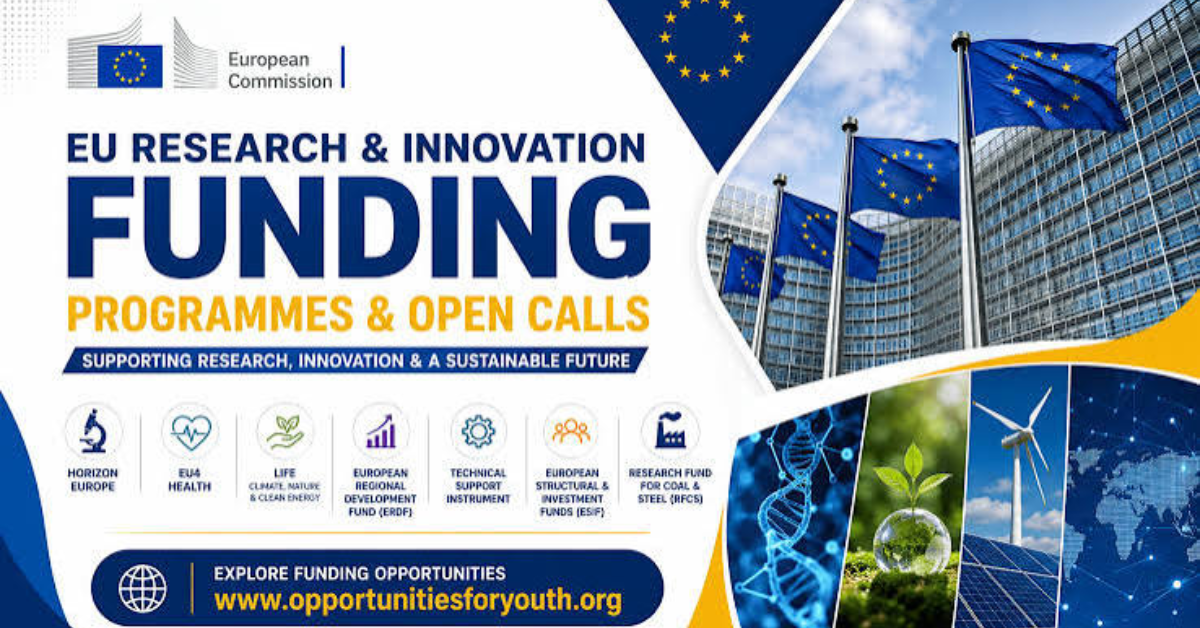
Researchers, universities, companies, startups, public bodies and innovation organisations looking for European Union funding in 2026 can explore opportunities under Horizon Europe, the EU’s flagship research and innovation funding programme.
Horizon Europe supports projects across science, technology, climate, health, digital transformation, industry, agriculture, energy, mobility, space, culture, security and other areas tied to Europe’s long-term research and competitiveness priorities.
The programme has an indicative budget of €93.5 billion for the 2021–2027 period following the EU’s Multiannual Financial Framework midterm review.
Rather than offering one single application round, Horizon Europe operates through multiple work programmes, calls and funding instruments. Applicants must therefore identify the specific call that matches their project and apply through the EU Funding & Tenders Portal.
Horizon Europe 2026: Key Details
Programme: Horizon Europe
Funding Body: European Commission
Programme Period: 2021–2027
Indicative Budget: €93.5 billion
Focus: Research and innovation
Eligible Organisations: Legal entities from the EU and associated countries, subject to individual call rules
Application System: EU Funding & Tenders Portal
Funding Areas: Research, innovation, health, climate, energy, digital technology, industry, space, agriculture, security, culture and more
Horizon Europe is designed to support high-quality research, strengthen European competitiveness, address global challenges and contribute to the United Nations Sustainable Development Goals.
What Is Horizon Europe?
Horizon Europe is the European Union’s central programme for financing research and innovation.
It supports projects that create new knowledge, technologies, products, services and solutions while helping the EU respond to major economic, social and environmental challenges.
The programme is intended to:
- Address climate change
- Support the Sustainable Development Goals
- Strengthen European competitiveness
- Encourage international research collaboration
- Improve the impact of research on policymaking
- Create jobs
- Develop research talent
- Promote industrial competitiveness
- Strengthen the European Research Area
Who Can Participate?
The European Commission states that legal entities from the EU and associated countries can participate in Horizon Europe.
Depending on the individual call, applicants may include:
- Universities
- Research institutes
- Companies
- Startups
- SMEs
- Public authorities
- Nonprofit organisations
- Research infrastructures
- Innovation organisations
- International partnerships
Exact eligibility varies by funding call, so applicants should always check the specific conditions attached to the opportunity they want to pursue.
How Horizon Europe Funding Is Structured
Horizon Europe is organised into several major pillars and complementary funding areas.
Understanding this structure can help applicants identify the part of the programme most relevant to their work.
Pillar I: Excellent Science
The first pillar focuses on strengthening high-quality scientific research and supporting researchers.
Major instruments include:
European Research Council
The European Research Council supports frontier research and highly ambitious scientific projects.
Marie Skłodowska-Curie Actions
Marie Skłodowska-Curie Actions support researcher training, mobility, doctoral education and international research careers.
Research Infrastructures
This area supports facilities, systems and resources that researchers need to conduct advanced scientific work.
Pillar II: Global Challenges and European Industrial Competitiveness
Pillar II supports research addressing major global challenges while strengthening European industry.
It is organised into six major clusters.
Cluster 1: Health
Health-related calls can support research addressing areas such as:
- Disease prevention
- Public health
- Medical technologies
- Health systems
- Biomedical research
- Digital health
- Cancer research
- Healthcare innovation
Health remains one of the major thematic areas within Horizon Europe.
Cluster 2: Culture, Creativity and Inclusive Society
This cluster focuses on issues involving:
- Culture
- Democracy
- Social inclusion
- Heritage
- Governance
- Social and economic transformation
- Creative industries
Researchers in humanities and social sciences may find opportunities particularly relevant in this area.
Cluster 3: Civil Security for Society
Funding under this cluster supports research and innovation around security.
Potential themes may include:
- Cybersecurity
- Disaster resilience
- Border security
- Crime prevention
- Emergency response
- Infrastructure protection
Cluster 4: Digital, Industry and Space
This cluster is especially relevant to technology companies, advanced manufacturers and digital researchers.
Potential areas include:
- Artificial intelligence
- Digital technologies
- Advanced manufacturing
- Industry
- Space
- Data
- Robotics
- Emerging technologies
The digital and industrial transformation of Europe is a major part of the Horizon Europe framework.
Cluster 5: Climate, Energy and Mobility
This cluster supports research and innovation addressing the climate transition.
Relevant fields may include:
- Renewable energy
- Clean transport
- Sustainable mobility
- Decarbonisation
- Climate technologies
- Energy systems
- Low-carbon infrastructure
Organisations working on climate and clean-energy innovation should monitor this cluster closely.
Cluster 6: Food, Bioeconomy, Natural Resources, Agriculture and Environment
The sixth cluster focuses on areas including:
- Agriculture
- Food systems
- Natural resources
- Environment
- Biodiversity
- Bioeconomy
- Sustainable land use
- Rural development
This creates opportunities for universities, agritech companies, environmental organisations and research institutions.
Pillar III: Innovative Europe
The third pillar focuses on turning research and innovation into commercial and societal impact.
It includes:
European Innovation Council
The European Innovation Council supports breakthrough technologies and high-risk, high-potential innovation.
It is particularly relevant to startups, scaleups and research teams developing technologies that could create new markets.
European Innovation Ecosystems
This area supports stronger links between entrepreneurs, investors, researchers and innovation organisations.
European Institute of Innovation and Technology
The EIT supports innovation communities connecting education, research and business.
Widening Participation and Strengthening the European Research Area
Horizon Europe also includes programmes designed to spread research excellence more widely and strengthen the European Research Area.
These activities support:
- Widening participation
- Research capacity
- Institutional development
- Reform of research systems
- Collaboration across regions and countries
Horizon Europe Missions
The programme also includes five major EU missions designed to direct research and innovation toward specific societal goals.
These are:
Adaptation to Climate Change
Supports work helping regions, communities and institutions become more resilient to climate impacts.
Climate-Neutral and Smart Cities
Supports cities working toward climate neutrality and sustainable urban transformation.
Cancer
Focuses on improving cancer prevention, diagnosis, treatment and quality of life.
Soil Deal for Europe
Supports healthier soils and sustainable land management.
Restore Our Ocean and Waters
Supports research and innovation aimed at protecting and restoring marine and freshwater ecosystems.
European Partnerships
Horizon Europe also supports European partnerships that bring together the EU, national authorities and private-sector organisations.
These partnerships coordinate research and innovation activities in strategic areas.
The Commission groups partnerships across themes including:
- Health
- Climate, energy and mobility
- Culture and inclusive society
- Digital, industry and space
- Food and natural resources
- Cross-cutting areas
How to Find Horizon Europe Funding Opportunities
Applicants should use the EU Funding & Tenders Portal to locate open and upcoming calls.
The European Commission states that application procedures and funding information are handled through this portal.
Potential applicants should search by:
- Research topic
- Call status
- Programme
- Deadline
- Funding instrument
- Sector
- Organisation type
Once a relevant call is identified, the complete call conditions should be reviewed before preparing a proposal.
Work Programmes Matter
Horizon Europe funding opportunities are defined through formal work programmes.
These documents explain which topics the European Commission intends to support, what budgets are available and what types of projects are expected.
Applicants should therefore avoid relying only on summaries or news articles.
The relevant work programme and official call documentation should be used when designing a project proposal.
Is There One Horizon Europe Deadline?
No.
Horizon Europe does not have a single universal application deadline.
Each call has its own:
- Opening date
- Closing date
- Budget
- Eligibility rules
- Funding conditions
- Project requirements
Applicants should therefore identify the specific 2026 opportunity relevant to their organisation and confirm its deadline through the official Funding & Tenders Portal.
Horizon Europe Info Days in 2026
The European Commission also organises information days to help prospective applicants understand specific clusters and funding instruments.
Examples listed for late 2026 include:
Cluster 4 – Digital, Industry and Space: 14–15 October 2026
Horizontal Activities Nature and Bridging Calls: 16 October 2026
Cluster 5 – Climate, Energy and Mobility: 19 November 2026
Cluster 1 – Health: 26 November 2026
These sessions can be useful for organisations preparing future applications.
Can International Organisations Participate?
International participation depends on the individual call and the country’s relationship with Horizon Europe.
The programme specifically supports international cooperation, while legal entities from EU and associated countries can participate generally.
Organisations outside those groups should review the eligibility requirements of the specific call they want to join.
International consortium building is common across many Horizon Europe projects.
What Types of Projects Are Competitive?
Strong Horizon Europe proposals typically need to show:
- A clearly defined research or innovation challenge.
- Strong scientific or technical quality.
- Alignment with the specific call topic.
- Clear expected impact.
- A credible implementation plan.
- Appropriate partners and expertise.
- European or international added value.
- Realistic project management and budgeting.
Applicants should develop proposals around the official call requirements rather than attempting to fit an unrelated project into an EU funding opportunity.
Horizon Europe Beyond 2027
The European Commission has also proposed a new Horizon Europe framework for 2028–2034.
The proposal includes a budget of approximately:
€175 billion
The proposed future framework would focus on research excellence, innovation and European competitiveness and would be linked closely with the European Competitiveness Fund.
However, this remains a proposal subject to negotiations between EU institutions.
Applicants seeking funding now should continue to focus on the current 2021–2027 programme and available 2026–2027 calls.
Final Thoughts
The Horizon Europe 2026 funding landscape offers a wide range of opportunities for researchers, universities, companies, public bodies and innovation organisations working across science, technology, climate, health, energy, mobility, agriculture, digital transformation and other fields.
With an indicative €93.5 billion programme budget for 2021–2027, Horizon Europe remains the European Union’s flagship research and innovation funding framework.
Funding opportunities are distributed through specific calls rather than one general application, so organisations should monitor the EU Funding & Tenders Portal and relevant work programmes throughout 2026.
Applicants who identify a strong match between their project and an official call can then develop consortium partnerships, prepare proposals and compete for European Commission funding.
SEO Keywords: Horizon Europe funding 2026, European Commission grants 2026, EU research funding, EU innovation grants, Horizon Europe calls 2026, European research grants, EU climate funding 2026, EU health research grants, European Innovation Council funding, Marie Curie funding, EU digital innovation grants, EU agriculture grants, research funding Europe, European Commission research grants, Horizon Europe opportunities
Also Check
Microsoft Paid Internship 2026 in Brussels: Earn €2,200 Monthly in a 12-Month European Policy Programme
CPJ Recruitment 2026: Apply for Remote Press Freedom Positions in Europe and Central Asia
Follow Us On Our Social Media Platforms
WhatsApp Group:
https://chat.whatsapp.com/CculATjfuTNKDISQGtP0uw?s=cl&p=a&mlu=4&ilr=4
WhatsApp Channel:
https://whatsapp.com/channel/0029Vb7isAg6buMKEWUmte0K
Facebook Page:

3 thoughts on “Horizon Europe and EU Research Funding 2026: Explore European Commission Research, Innovation, Climate, Health and Regional Development Funding Opportunities”