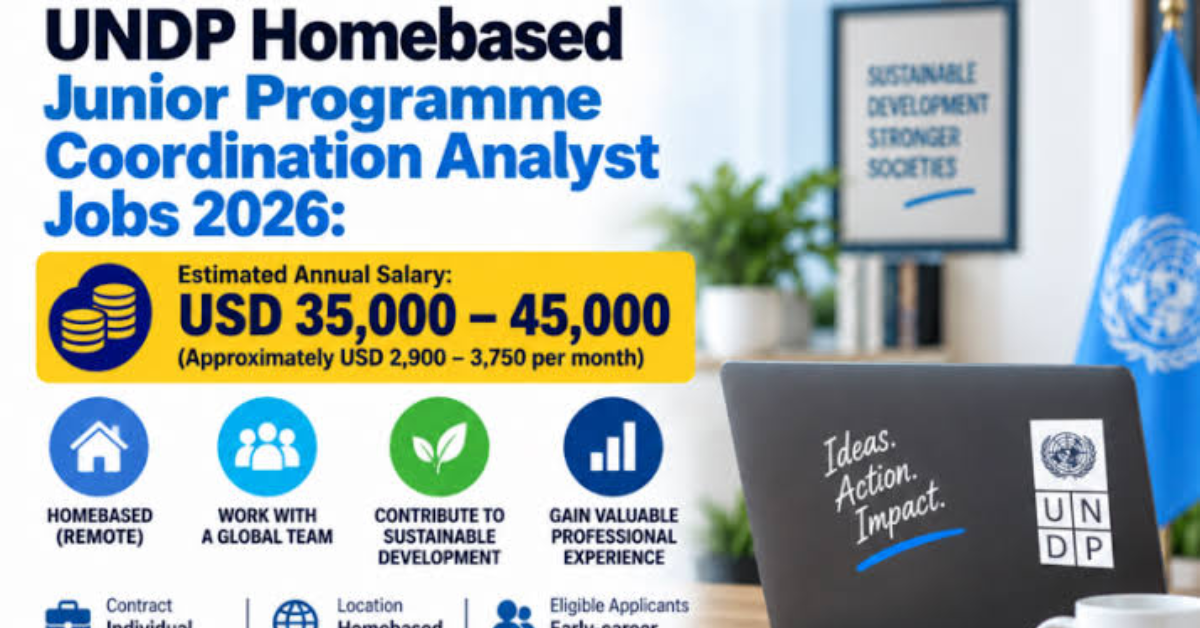
The United Nations Development Programme (UNDP) is recruiting a Junior Programme Coordination Analyst for a home-based international consultancy supporting the Global Partnership for Effective Development Co-operation.
This opportunity is particularly attractive to early-career professionals interested in programme coordination, international development, development cooperation, advocacy, communications, policy research and stakeholder engagement.
A major advantage of the vacancy is its flexible experience requirement.
Candidates with a relevant Master’s degree or equivalent are not required to have previous professional work experience, while applicants with a relevant Bachelor’s degree need at least two years of qualifying professional experience.
The role is classified at IPSA-8 level, is internationally recruited, and is home-based.
Applications close on September 15, 2026.
UNDP Junior Programme Coordination Analyst 2026: Key Details
Organization: United Nations Development Programme
Position: Junior Programme Coordination Analyst
Contract Level: IPSA-8
Contract Type: Consultancy
Recruitment Type: International
Working Arrangement: Home-Based / Remote
Area of Work: Programme and Project Management / Management and Strategy
Education: Master’s degree or Bachelor’s degree in a relevant field
Experience with Master’s: No professional work experience required
Experience with Bachelor’s: Minimum two years of relevant experience
Language: Fluency in English required
French and/or Spanish: Advantage
Travel: No travel currently foreseen
Application Deadline: September 15, 2026
The vacancy is open to both internal and external applicants.
Background & Job Description
UNDP operates across 166 countries and territories, supporting governments and partners in implementing policies, institutions and partnerships connected with the 2030 Agenda for Sustainable Development and the Sustainable Development Goals.
The Junior Programme Coordination Analyst will work within UNDP’s Effective Development Cooperation Team, which is located within the Bureau for External Relations and Advocacy.
The team provides policy and technical support to partner countries and United Nations Country Teams while supporting the Global Partnership for Effective Development Co-operation, also known as the GPEDC.
The GPEDC was established through the Busan Partnership Agreement in 2011.
It brings together governments, bilateral and multilateral organizations, civil society, the private sector, parliaments, trade unions and other actors interested in improving the effectiveness of development cooperation.
Its current 2023–2026 Work Programme focuses on evidence generation, policy dialogue, strategic partnerships and advocacy around effective development cooperation.
What Will the Programme Coordination Analyst Do?
The successful candidate will support the final year of the current 2023–2026 GPEDC Work Programme while also contributing to planning for the next 2027–2030 Work Programme.
The role combines:
- Programme coordination
- Event support
- Communications
- Advocacy
- Secretariat responsibilities
- Research
- Stakeholder engagement
- Website updates
- Country-level knowledge products
The analyst will work closely with the UNDP/Joint Support Team and report to the Partnership and Advocacy Specialist under the overall supervision of the GPEDC Team Lead.
Support GPEDC Events and Programme Activities
A major part of the role involves providing substantive support to GPEDC work and events.
This includes helping draft and edit:
- Concept notes
- Moderation notes
- Speaker invitations
- Speaker biographies
- Communications materials
- Other substantive programme documents
The analyst will also collect and track feedback from stakeholders and help determine how that feedback should be incorporated into draft materials.
The position therefore requires strong written communication and editing skills.
Candidates should be comfortable working with policy-oriented documents and communicating with multiple stakeholders.
Meeting and Follow-Up Support
The analyst will follow up on discussions within the team and with external stakeholders.
Responsibilities will include:
- Taking meeting minutes
- Tracking action points
- Supporting follow-up
- Helping coordinate preparations for GPEDC work and events
This means strong organizational skills are essential.
Applicants should be able to manage different tasks simultaneously while keeping accurate records and ensuring deadlines are met.
Communications and Website Support
The Programme Coordination Analyst will also contribute to communications activities.
This can include:
- Updating website content
- Disseminating promotional materials
- Drafting press releases
- Developing social media toolkits
Applicants with experience in communications, outreach or digital content may therefore be particularly competitive.
Experience translating complex policy issues into accessible communications products can also be valuable.
Speaker Outreach and Event Coordination
Another important responsibility is speaker coordination.
The successful candidate will lead speaker outreach and confirmation under the guidance of the Partnership and Advocacy Specialist.
They may also help prepare communications and planning documents for major events such as:
- GPEDC High-Level Meetings
- Busan Forums
- Regional events
- Global policy forums
- Side events and stakeholder meetings
The analyst will also help ensure logistics are managed appropriately by event sponsors and communicated clearly to participating stakeholders.
Support Advocacy and Country-Level Work
The role also supports GPEDC advocacy and country-level activities.
One key responsibility is helping Steering Committee members implement the final year of the current 2023–2026 Advocacy and Outreach Plan and contribute to development of a new plan aligned with the 2027–2030 Work Programme.
The analyst will also contribute to the outcomes of the fourth monitoring round, which is expected to conclude in 2026.
This may involve drafting:
- Stories of progress
- Blogs
- Short policy summaries
- Action Dialogue summaries
- Development cooperation updates
The role therefore offers valuable exposure to international policy processes.
Updating More Than 100 Country Pages
The analyst will also support updates to more than 100 country pages on the GPEDC website.
These updates will be based on monitoring countries announced after relevant summits and countries engaged in the 2023–2026 monitoring cycle.
This responsibility highlights the importance of accuracy, organization and the ability to work with large volumes of information.
Candidates with experience in website content management, knowledge management or international development databases may find this particularly relevant.
Qualifications – Education
UNDP requires either an advanced university degree or a relevant Bachelor’s degree with additional experience.
A Master’s degree or equivalent should be in a field such as:
- Public Administration
- Public Policy
- International Relations
- International Affairs
- Politics
- International Development Studies
- Economics
- Business Administration
- Social Sciences
- Related disciplines
Alternatively, a Bachelor’s degree in one of these areas may be considered if combined with the required professional experience.
Master’s Degree: No Work Experience Required
One of the strongest features of this vacancy is that candidates with a relevant Master’s degree do not need prior professional work experience.
This makes the position particularly relevant to:
- Recent Master’s graduates
- Early-career development professionals
- Graduates seeking UN experience
- Young professionals transitioning into international development
- Candidates with strong academic and internship backgrounds
Applicants should still demonstrate relevant knowledge and competencies even though professional experience is not mandatory.
A strong application should show evidence of skills in policy analysis, communications, research, stakeholder engagement or programme coordination.
Bachelor’s Degree: Two Years of Experience Required
Applicants holding only a Bachelor’s degree need at least two years of relevant professional experience.
This experience should be at the national or international level and relate to programme coordination and management.
Candidates with Bachelor’s degrees should therefore clearly explain their responsibilities and achievements in previous positions.
Relevant experience could include work involving:
- Programme coordination
- Project management
- International development
- NGO programmes
- Government programmes
- Development cooperation
- Policy research
- Communications
- Advocacy
- Stakeholder engagement
The education and experience rules are explicit: Master’s-level applicants do not need professional work experience, while Bachelor’s-level applicants require at least two years.
Experience and Knowledge Required
UNDP is seeking candidates with knowledge and experience in several related areas.
Applicants should ideally demonstrate:
Development cooperation knowledge
Candidates should understand development cooperation and broader aid-effectiveness issues.
Policy research
Experience researching policy issues and contributing to policy or knowledge products is important.
Administrative and coordination experience
Applicants should be capable of planning, organizing and reporting on programme tasks.
Communications and outreach
Experience producing communications materials or supporting outreach activities is valuable.
Multi-stakeholder partnerships
Candidates should understand how to work with organizations and stakeholders from different sectors.
Conference and workshop support
Experience supporting conferences or workshops, particularly within the UN or international organizations, can strengthen an application.
Microsoft Office skills
Applicants should be proficient in Word, Excel, PowerPoint and Outlook.
Developing Country Experience
Experience working in developing-country environments is also relevant.
Because the Global Partnership works extensively with governments and development partners across different regions, candidates who understand development challenges and policy environments in developing countries may have an advantage.
Applicants should highlight any direct experience they have gained through:
- Employment
- Consultancy
- Internships
- Research
- Volunteer work
- Field projects
- Development programmes
where relevant.
Knowledge of GPEDC
Familiarity with the Global Partnership for Effective Development Co-operation is specifically identified as useful.
Applicants should therefore understand the organization’s basic purpose before applying.
At minimum, candidates should be familiar with:
- Development effectiveness
- Aid effectiveness
- Multi-stakeholder partnerships
- Development cooperation monitoring
- The Sustainable Development Goals
- Policy dialogue
- Development financing
Demonstrating this understanding in an application can show that the candidate has taken time to understand the role.
Core Competencies
UNDP identifies several core competencies at Level 1.
These include:
Achieve Results
Candidates should plan their work carefully, pay attention to detail and deliver quality work by deadlines.
Think Innovatively
The successful candidate should be open to new ideas and capable of practical problem-solving.
Learn Continuously
UNDP values curiosity, knowledge sharing and willingness to learn.
Adapt with Agility
The analyst should remain flexible when working in changing or uncertain environments.
Act with Determination
Candidates should demonstrate motivation and reliability.
Engage and Partner
Strong interpersonal skills and an ability to build positive relationships are important.
Enable Diversity and Inclusion
Candidates should respect differences and contribute to an inclusive workplace.
Technical Competencies
The position also requires several technical competencies.
Project Management
Applicants should understand how to plan, organize and prioritize activities in order to achieve goals.
Communication
Strong written and verbal communication is essential.
Candidates should be capable of tailoring messages to different audiences.
Client Management
The analyst should respond efficiently to stakeholder needs and deliver timely, quality results.
Web and Social Media Analytics
The successful candidate should understand how to analyze web and social-media performance data.
Writing and Editing
The role requires strong writing and editing skills for different types of communications and policy content.
Development Partnership Architecture
Candidates should understand principles and commitments relating to effective development cooperation and how they are monitored.
Language Requirements
Fluency in English is mandatory.
Knowledge of French and/or Spanish is considered an advantage.
This means French and Spanish are not required for eligibility, but candidates who speak either language should make this clear in their applications.
Is This Position Really Home-Based?
Yes.
The vacancy is listed as home-based / remote work.
No regular office presence is indicated.
The listing associates the position with Geneva, but the working arrangement itself is home-based.
Candidates should therefore distinguish between the administrative duty-station context and the actual remote work arrangement.
This is also an internationally recruited IPSA consultancy.
Travel Requirements
No travel is currently foreseen for the assignment.
However, if official travel becomes necessary later, UNDP states that it will cover approved business travel expenses.
This makes the position particularly attractive to professionals seeking a primarily home-based international development role.
How to Strengthen Your Application
Candidates should tailor their application around the vacancy rather than submitting a generic UN CV.
Applicants with a Master’s degree should focus on showing evidence of relevant knowledge and transferable skills, even if they have limited professional experience.
Examples could include:
- Academic research
- Thesis work
- Internships
- Policy projects
- Development research
- University projects
- Volunteer activities
- International development coursework
Bachelor’s-level candidates should clearly show at least two years of relevant programme coordination or management experience.
In both cases, applications should highlight concrete evidence of writing, coordination, stakeholder engagement and communications skills.
Important Keywords for Your Application
Candidates may naturally highlight relevant terms from the vacancy where they genuinely reflect their experience.
These include:
programme coordination, development cooperation, policy research, advocacy, stakeholder engagement, development effectiveness, international development, communications, partnership management, event coordination, policy briefs, social media, knowledge management and project management.
Applicants should avoid copying keywords into their CV without evidence.
Every skill should be backed by an example or responsibility where possible.
UNDP Tiered Recruitment Approach
UNDP notes that many vacancies are advertised using a tiered approach designed to protect existing organizational capacity.
The vacancy is open to internal and external applicants.
UNDP defines Tier 0, Tier 1 and Tier 2 primarily around existing UNDP, UNCDF and UNV personnel, while Tier 3 or vacancies with no specific tier may include external candidates.
Applicants should always check the vacancy title and recruitment instructions to make sure they satisfy the eligibility conditions.
Equal Opportunity
UNDP states that it is an equal-opportunity employer.
Recruitment decisions are based on merit and suitability for the role, and qualified applicants from different backgrounds are encouraged to apply.
The organization also states that it does not tolerate discrimination, harassment, exploitation or abuse of authority.
Selected candidates are subject to relevant checks and must comply with UNDP standards.
UNDP Does Not Charge Application Fees
Applicants should never pay anyone to apply for this vacancy.
UNDP states explicitly that it does not charge a fee at any stage of recruitment.
Requests for payment connected with job applications, interviews or recruitment should therefore be treated as suspicious.
Application Deadline
The vacancy closes on:
September 15, 2026
Because online recruitment systems may operate according to a specified timezone, applicants should avoid submitting at the last minute.
The listing indicates that the corresponding deadline in the Africa/Harare timezone falls in the early hours of September 16, 2026.
However, candidates should follow the official UNDP recruitment platform deadline rather than relying only on timezone conversions.
Who Should Apply?
This vacancy could be especially relevant to:
- Recent Master’s graduates in international development
- Public Policy graduates
- International Relations graduates
- Economics graduates
- Public Administration graduates
- Social Science graduates
- Junior Programme Officers
- Project Coordinators
- Policy Researchers
- Development Cooperation Professionals
- Communications Officers
- NGO Programme Professionals
- Early-career UN applicants
The home-based structure and Master’s-level no-experience pathway make it particularly attractive for candidates trying to enter the UN and international development sector.
Final Thoughts
The UNDP Junior Programme Coordination Analyst – Home-Based 2026 vacancy provides an excellent opportunity for candidates seeking experience with the United Nations Development Programme and the Global Partnership for Effective Development Co-operation.
The position combines programme coordination, communications, policy work, stakeholder engagement, advocacy and event support.
Candidates with a relevant Master’s degree or equivalent can apply without professional work experience, while those with a Bachelor’s degree need at least two years of qualifying experience.
Fluency in English is required, while French or Spanish can strengthen an application.
The role is home-based, internationally recruited and currently involves no planned travel.
Applications close on September 15, 2026.
Qualified candidates should prepare a targeted application demonstrating strong writing, programme coordination, communications, policy-research and stakeholder-engagement skills.
SEO Keywords: UNDP Jobs 2026, UNDP Junior Programme Coordination Analyst, UNDP Home Based Jobs 2026, UNDP Remote Jobs 2026, United Nations Remote Jobs 2026, UN Jobs No Experience 2026, UNDP Jobs No Experience, UN Jobs for Master’s Graduates, UNDP Jobs for Recent Graduates, UNDP IPSA 8 Jobs, IPSA 8 UNDP Jobs, International Development Jobs 2026, Programme Coordination Jobs UNDP, Remote UN Jobs Worldwide, Home Based UN Jobs, United Nations Development Programme Careers, UNDP Consultancy Jobs 2026, UN Jobs Bachelor Degree 2 Years Experience, UNDP Master’s Degree Jobs, UN Jobs International Relations Graduates, UN Jobs Public Policy Graduates, UN Jobs Development Studies Graduates, UN Jobs Economics Graduates, UN Jobs Social Sciences Graduates, Global Partnership Effective Development Cooperation Jobs, GPEDC Jobs 2026, Development Cooperation Jobs 2026, UN Programme Analyst Jobs, Early Career UN Jobs 2026, UNDP Remote Consultancy, Internationally Recruited UNDP Jobs, Remote International Development Jobs, UNDP Geneva Jobs 2026, Home Based Programme Analyst Jobs, UN Jobs September 2026, United Nations Programme Coordination Jobs
Also Check
IOC Olympic Studies Centre Research Grant 2027: Up to USD 6,000 for PhD Students & Early Career Academics
Work Remotely on Africa’s Industrial Future: DSI/NRF SARChI Offers Up to $15,000 for 3 Research Commissions in 2026 (Fully Funded)
PILnet Is Hiring a Program Consultant (East Africa) | Remote NGO Consultancy | USD 1,300–1,600/Month
Follow Us On Our Social Media Platforms
WhatsApp Group:
https://chat.whatsapp.com/CculATjfuTNKDISQGtP0uw?s=cl&p=a&mlu=4&ilr=4
WhatsApp Channel:
https://whatsapp.com/channel/0029Vb7isAg6buMKEWUmte0K
Facebook Page:
