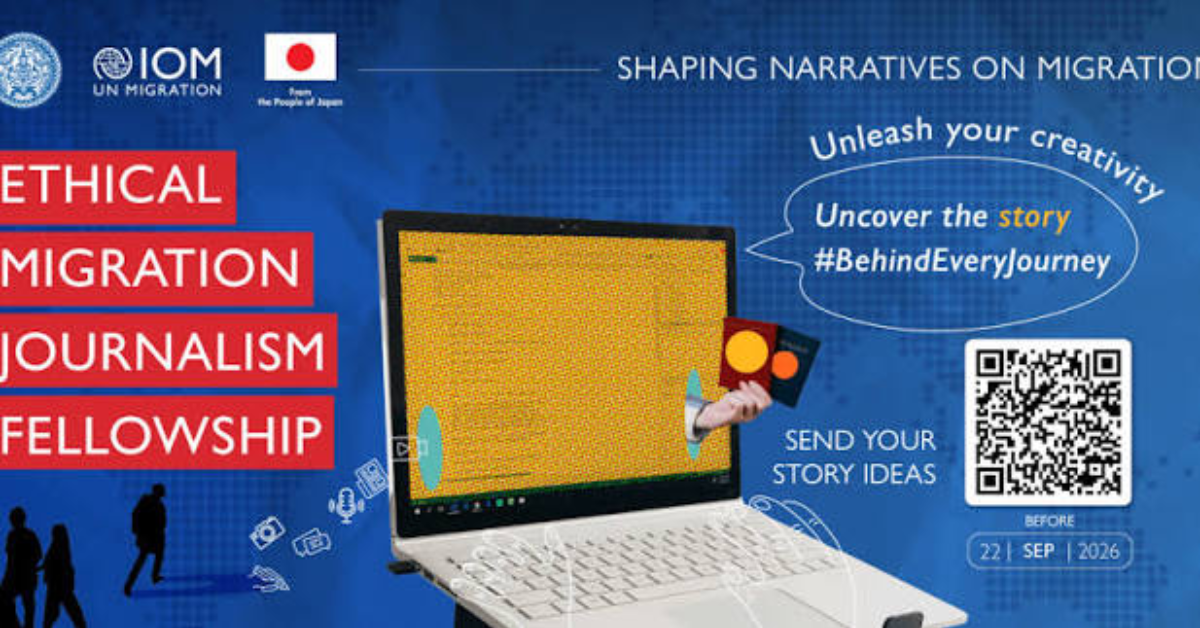
Journalists and students interested in migration reporting can apply for the IOM Ethical Migration Journalism Fellowship 2026: USD 1,000 Grant for Journalists and Students in Thailand, a three-month programme designed to strengthen ethical, accurate, and balanced journalism on migration.
The fellowship is being organized by the International Organization for Migration (IOM) in partnership with Thailand’s Ministry of Foreign Affairs.
Five selected fellows will each receive a USD 1,000 reporting grant, together with mentorship, editorial guidance and technical support to develop original, evidence-based stories focusing on migration in Chiang Rai and/or surrounding areas.
The programme runs from 1 October to 31 December 2026, with completed stories due by 8 January 2027.
Applications close on 22 September 2026.
The opportunity is open to journalists and students based in Chiang Rai, regardless of nationality, provided they meet the programme’s training and other eligibility requirements.
About the IOM Ethical Migration Journalism Fellowship
The Ethical Migration Journalism Fellowship Programme seeks to improve the quality of reporting surrounding migration in Thailand.
Migration can involve complex issues ranging from employment and cross-border movement to migrant rights, community relations and social inclusion.
How these issues are presented through journalism can influence public understanding and attitudes toward migrants.
IOM is therefore investing in journalists and emerging storytellers who can produce responsible reporting that is accurate, balanced, evidence-based and sensitive to the experiences of migrants.
The programme builds on migration-reporting training sessions organized by IOM across Thailand.
These initiatives have helped participants strengthen their understanding of migration while developing skills in ethical and conflict-sensitive journalism.
Five Fellows Will Be Selected
The fellowship is intentionally small.
IOM states that five fellows will be selected for the 2026 programme.
Each fellow will spend approximately three months developing an original migration story connected to Chiang Rai and/or surrounding areas.
Participants will receive both financial and professional support throughout the reporting process.
This structure means the programme is not simply a cash grant.
Successful applicants will participate in a guided journalism development process involving mentorship, technical support, editorial input, and opportunities for professional exchange.
USD 1,000 Reporting Grant
Each selected fellow will receive a USD 1,000 reporting grant.
The grant is intended to support the production of an original story about migration.
Applicants should therefore view the USD 1,000 as a reporting grant connected to the fellowship project, rather than a general personal scholarship or unrestricted cash award.
The funding is intended to help fellows carry out the reporting necessary to produce their proposed story.
Applicants should develop realistic story ideas that can be completed within the programme’s timeframe and available resources.
What Fellows Will Receive
Financial support is only one part of the fellowship.
Selected participants will receive a package of professional development opportunities throughout the programme.
This includes a USD 1,000 reporting grant for producing an original migration story.
Fellows will also receive mentorship and editorial guidance throughout the reporting process.
Technical support will be available from IOM experts and partners to strengthen research and help fellows refine their reporting approaches.
Participants will have opportunities to exchange experiences with foreign correspondents.
The programme will also help fellows develop their skills in responsible migration journalism, ethical interviewing and conflict-sensitive reporting.
Completed stories may have opportunities to be published through IOM platforms.
Who Can Apply?
Eligibility for the fellowship is geographically specific.
Applicants must be a journalist or student based in Chiang Rai, Thailand.
There is, however, no nationality restriction.
This means international students or foreign journalists living in Chiang Rai may potentially apply if they satisfy all of the other requirements.
Applicants should not confuse “regardless of nationality” with worldwide eligibility.
A journalist or student living outside Chiang Rai would not meet the location requirement stated in the official fellowship announcement.
Journalism Training Requirement
Applicants must also satisfy an important training condition.
Candidates need to have completed either the IOM-organized Training on Migration Reporting or specified online migration journalism courses offered through the Global Migration Media Academy (GMMA).
For applicants choosing the online route, both required modules must be completed:
Migration Explained
and
Reporting Migration in Thailand
Applicants need to provide evidence of completing the relevant training as part of their fellowship application.
This requirement means interested candidates who have not previously attended IOM’s in-person migration reporting training may still have a route to eligibility through the designated online courses.
Interest in Migration Reporting
Candidates must demonstrate a strong interest and commitment to reporting on migration.
The programme is particularly focused on journalism that is:
Accurate
Balanced
Ethical
These principles are central to the fellowship.
Applicants should therefore demonstrate not only an interest in migration as a subject but also an understanding of the responsibilities associated with reporting on people and communities affected by migration.
Story Proposal Requirement
Every applicant must submit an original and feasible story proposal.
The proposed story should relate to migration in Chiang Rai and/or surrounding areas.
Feasibility is important.
Applicants should develop an idea that can realistically be researched, reported, and completed within the fellowship timeframe.
A strong proposal should have a clear focus rather than attempting to cover migration in Thailand as an excessively broad subject.
Applicants can consider how their proposed story could provide new perspectives while remaining grounded in evidence, local realities and migrant experiences.
Ethical Migration Journalism
Ethics are central to this fellowship.
Migration stories can involve people facing economic hardship, displacement, discrimination, exploitation or other vulnerabilities.
Journalists therefore need to consider how reporting practices affect the people whose experiences they document.
The programme aims to strengthen skills in responsible migration reporting and ethical interviewing.
Fellows will also develop knowledge of conflict-sensitive reporting, helping them understand how journalistic framing and language can influence tensions, stereotypes and public perceptions.
Evidence-Based Storytelling
IOM emphasizes the importance of stories grounded in evidence.
Fellows should therefore move beyond assumptions or stereotypes when reporting on migration.
Their work should reflect credible information, local realities and the experiences of migrants themselves.
This evidence-based approach can help audiences develop a more accurate and balanced understanding of migration.
The programme seeks to encourage reporting that makes a meaningful contribution to communities rather than simply attracting attention through sensational headlines.
Mentorship and Editorial Support
Selected fellows will not develop their stories entirely independently.
IOM will provide mentorship and editorial guidance throughout the reporting process.
This support can help participants strengthen story structure, research approaches, interviewing techniques, and journalistic presentation.
IOM experts and partners will also provide technical assistance.
For students and emerging storytellers, access to professional guidance may be particularly valuable for developing practical reporting skills.
Experienced journalists can also benefit from specialized expertise relating to migration and ethical reporting.
Exchange With Foreign Correspondents
Another benefit is the opportunity to exchange experiences with foreign correspondents.
International journalists can bring different perspectives concerning reporting methods, professional standards and approaches to covering complex migration issues.
These interactions can create useful opportunities for professional learning and networking.
The programme therefore combines local reporting with exposure to broader journalistic perspectives.
Chiang Rai Field Visit
Successful applicants will be expected to participate in a field visit within Chiang Rai organized by IOM.
The field visit is intended to deepen fellows’ understanding of local migration dynamics.
Participants will also have opportunities to exchange experiences with foreign correspondents and other relevant stakeholders.
The field component is important because the fellowship focuses specifically on locally grounded migration journalism.
Direct engagement with communities and relevant stakeholders can help journalists develop stories reflecting realities beyond desk research.
Online Orientation and Monthly Check-Ins
Fellows must participate in an online orientation session.
They are also expected to participate in monthly check-ins organized by IOM throughout the fellowship period.
These sessions allow fellows to receive guidance, discuss progress, and address challenges encountered while developing their stories.
Applicants should therefore ensure they can commit sufficient time not only to reporting but also to the programme’s structured activities.
Fellowship Duration
The programme lasts approximately three months.
The official fellowship period is:
1 October–31 December 2026.
During this period, fellows will research, develop and produce their proposed migration stories.
The final completed story must be submitted by:
8 January 2027.
Applicants should ensure that their academic, employment and personal commitments allow them to complete the reporting project within this timeframe.
Application Requirements
Candidates must submit several documents as part of the application process.
Applicants need an updated resume or CV.
They must also prepare a cover letter explaining their motivation for applying and providing a short overview of their proposed story idea.
The cover letter must not exceed one page.
Candidates must additionally complete the official Story Proposal Form.
Evidence of completing the required IOM migration reporting training or GMMA online courses must also be submitted.
Journalist applicants must provide two relevant examples of previous work.
The requirement for work samples is specifically identified for journalist applicants.
What to Include in the Cover Letter
The cover letter should explain why the applicant wants to join the fellowship.
Candidates should connect their professional, academic, or personal interests with migration journalism and explain why responsible reporting matters to them.
The letter should also briefly introduce the proposed story.
Since the maximum length is one page, applicants should keep their writing focused.
A clear explanation of motivation and a strong story concept will generally be more effective than filling the letter with unrelated biographical information.
Developing a Strong Story Proposal
The fellowship specifically asks for an original and feasible migration story.
Applicants should therefore identify a focused issue that can realistically be investigated within the available timeframe.
A strong proposal should explain what the story is about, why it matters, and how the applicant intends to report it.
The proposal should also be connected to Chiang Rai and/or surrounding areas.
Candidates can consider how the story will incorporate evidence, local realities and migrant perspectives.
Because ethical journalism is central to the programme, applicants should also consider how interviews and potentially sensitive information will be handled responsibly.
Important Dates
The fellowship follows a relatively fast selection timeline.
Applications Open: 1 September 2026
Application Deadline: 22 September 2026
Shortlisting and Interviews: 23–25 September 2026
Selection Announcement: 29 September 2026
Fellowship Period: 1 October–31 December 2026
Final Story Submission: 8 January 2027
Candidates should therefore be prepared to begin the fellowship shortly after the selection results are announced.
Is the Fellowship Open to International Applicants?
The answer requires an important qualification.
The fellowship is open to applicants regardless of nationality, but applicants must be based in Chiang Rai.
Therefore, a non-Thai journalist or international student currently based in Chiang Rai could potentially qualify.
However, someone living in another country should not interpret the nationality provision as meaning that IOM will relocate them to Thailand for the fellowship.
The official announcement does not present this as a worldwide relocation or travel-funded fellowship.
Is Travel to Thailand Funded?
The official programme information does not state that IOM will provide international airfare, visa sponsorship, or relocation assistance for applicants living outside Thailand.
This is consistent with the requirement that candidates already be based in Chiang Rai.
The USD 1,000 award is described specifically as a reporting grant to support production of the fellow’s original migration story.
Applicants should therefore not describe the programme as a fully funded international fellowship involving travel to Thailand.
Is This a Job With IOM?
No employment relationship is stated in the supplied fellowship announcement.
The programme is a journalism fellowship with a reporting grant, mentorship and professional development support.
It should not be confused with an IOM staff position.
Successful fellows will receive support to produce migration journalism rather than being recruited as permanent IOM employees.
Who Should Consider Applying?
The fellowship is particularly suitable for journalists and students who are already based in Chiang Rai and have a genuine interest in migration.
Journalists who want to strengthen their ethical reporting techniques may find the programme useful.
Students interested in journalism, communications, migration, international affairs or related areas may also consider applying if they satisfy the requirements.
Candidates should be comfortable conducting research and interviews and should have enough time to develop an original story during the three-month programme.
How to Apply
Applicants should use the official IOM Thailand fellowship application instructions.
Before submitting, candidates should prepare their updated CV, one-page cover letter, completed Story Proposal Form, and certificate showing completion of the relevant migration journalism training.
Journalist applicants should additionally prepare two relevant work samples.
Candidates who rely on the GMMA online training route need to complete both required modules before applying.
All documents should be checked carefully before submission.
Application Deadline
The deadline is 22 September 2026.
Because shortlisting and interviews are scheduled for 23–25 September, applicants should not expect a lengthy extension period after the stated closing date.
Selection results are expected on 29 September 2026, with the fellowship beginning on 1 October 2026.
Candidates interested in applying should therefore complete the required training and application documents as soon as possible.
Funding From the Government of Japan
The Ethical Migration Journalism Fellowship initiative is made possible through funding from the Government of Japan.
The programme itself is implemented through IOM in partnership with Thailand’s Ministry of Foreign Affairs.
Applicants should rely on official IOM Thailand information for updates concerning the programme, application process and fellowship requirements.
Final Considerations
The IOM Ethical Migration Journalism Fellowship 2026: USD 1,000 Grant for Journalists and Students in Thailand provides a targeted opportunity for journalists and emerging storytellers interested in responsible migration reporting.
Five fellows will each receive a USD 1,000 reporting grant, together with mentorship, editorial guidance, technical assistance, professional exchanges and opportunities to publish completed work through IOM platforms.
The fellowship runs from 1 October to 31 December 2026, with final stories due on 8 January 2027.
Applicants must be journalists or students based in Chiang Rai, regardless of nationality, and must have completed the required IOM training or designated GMMA e-learning modules.
They must also submit an original and feasible migration story proposal relating to Chiang Rai and/or surrounding areas.
Applications close on 22 September 2026.
For journalists and students who meet the location and training requirements, this fellowship provides an opportunity to receive both financial and professional support while contributing to more accurate, balanced and ethical public understanding of migration.
SEO Keywords: IOM Ethical Migration Journalism Fellowship 2026, IOM journalism fellowship 2026, USD 1000 journalism grant, journalism grants Thailand 2026, IOM Thailand fellowship, migration journalism fellowship, Ethical Migration Journalism Fellowship Programme, grants for journalists 2026, journalism opportunities for students, Chiang Rai journalism fellowship, migration reporting grants, IOM opportunities 2026, journalism fellowships Asia, ethical journalism training, Global Migration Media Academy, GMMA migration journalism, reporting grants for journalists, Thailand journalism opportunities 2026, migration journalism Thailand, IOM student opportunities
Also Check
SUSTAIN Europe Job Placement Programme 2026: Job Opportunities for Nigerian STEM Professionals
Fully Funded Geneva Travel Grant 2026: UNEP Global Chemicals Conference Opens Applications for Youth
African School of Governance Teaching Assistant & Teaching Fellow Jobs 2026/27 (Kigali, Rwanda)
Follow Us On Our Social Media Platforms
WhatsApp Group:
https://chat.whatsapp.com/CculATjfuTNKDISQGtP0uw?s=cl&p=a&mlu=4&ilr=4
WhatsApp Channel:
https://whatsapp.com/channel/0029Vb7isAg6buMKEWUmte0K
Facebook Page:

2 thoughts on “IOM Ethical Migration Journalism Fellowship 2026: USD 1,000 Grant for Journalists and Students in Thailand”