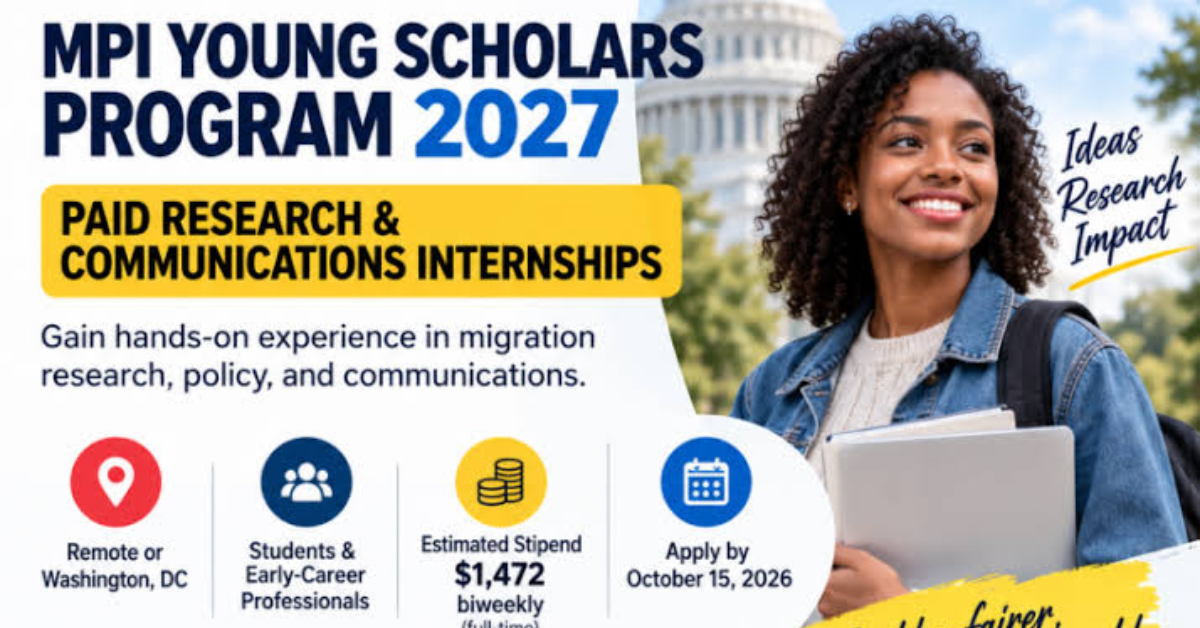
Students, recent graduates, and early-career professionals interested in migration policy, international affairs, research, communications, and public policy can apply for the Migration Policy Institute (MPI) Young Scholars Program 2027.
Officially known as the:
Demetrios G. Papademetriou Young Scholars Program
The initiative provides paid internship opportunities with the Migration Policy Institute.
For the Spring 2027 cycle, applicants can pursue internships in:
Research
or:
Communications.
A major advantage of the programme is its flexibility.
Internships can be:
Remote
or:
In person.
Importantly, MPI also states that internships are available to people:
Residing outside the United States.
Full-time interns receive a:
$1,472 biweekly stipend
while part-time interns receive a:
Prorated stipend.
The Spring 2027 internship cycle generally runs from:
January through April 2027.
The application deadline is:
October 15, 2026.
About the Migration Policy Institute
The Migration Policy Institute is an organization specializing in research and analysis relating to migration and immigration policy.
Its work addresses subjects including:
Immigration systems.
Refugees and asylum.
Borders.
Immigrant integration.
Education.
Labor markets.
Migration and development.
MPI produces policy research and analysis intended to inform public understanding and decision-making around migration.
About the Demetrios G. Papademetriou Young Scholars Program
The internship programme is named in honor of:
Demetrios G. Papademetriou
who was the founding president of the Migration Policy Institute.
The Young Scholars Program has two central objectives.
First, it allows interns to contribute to:
MPI’s work.
Second, it seeks to:
Train the next generation of migration and communications leaders.
The programme was officially named the Demetrios G. Papademetriou Young Scholars Program in:
2021.
Papademetriou led MPI from its establishment in 2001 until 2014 and later served as President Emeritus and Distinguished Transatlantic Fellow.
Spring 2027 Internships
The Spring 2027 internship cycle generally covers:
January–April 2027.
MPI indicates that there is some flexibility regarding the exact internship:
Start dates.
End dates.
The overall programme operates through three internship cycles each year.
These are:
Spring: January–April
Summer: May–August
Fall: September–December.
Spring Application Deadline
Applications for the Spring semester are due:
October 15.
For the current recruitment cycle, applicants are instructed to submit the required Spring 2027 materials by:
October 15, 2026.
Candidates should apply early enough to avoid technical or documentation problems close to the deadline.
Summer Internship Deadline
Candidates unable to apply for Spring can monitor subsequent cycles.
The general deadline for the:
Summer semester
is:
February 15.
Summer internships generally run from:
May through August.
Fall Internship Deadline
The general application deadline for the:
Fall semester
is:
June 15.
Fall internships generally run from:
September through December.
Candidates should verify dates on MPI’s official internship page for each new cycle.
Internship Duration
The internship programme lasts approximately:
Four months.
This makes it a relatively substantial internship experience compared with shorter programmes lasting only several weeks.
Interns have an opportunity to become involved in ongoing research, communications and policy-related work throughout their cycle.
$1,472 Biweekly Stipend
Full-time interns receive:
$1,472 every two weeks.
MPI describes this as a:
Biweekly stipend.
Part-time interns receive a:
Prorated stipend.
This means the exact amount received by a part-time intern will depend on the applicable workload and arrangement.
How Much Could a Full-Time Intern Receive?
Because the programme lasts approximately four months, the exact total will depend on the internship dates and number of biweekly payment periods.
For illustration, eight biweekly payments at $1,472 would equal:
$11,776.
However, this is only a mathematical illustration and should not be presented as a guaranteed total internship award.
The official programme specifies the payment rate as:
$1,472 biweekly for full-time interns.
Applicants should rely on that rate rather than assuming a fixed total payment.
Full-Time and Part-Time Opportunities
Internships are available on both a:
Full-time
and:
Part-time
basis.
However, MPI specifically seeks full-time availability for:
U.S. Immigrant Integration
and:
Communications.
Candidates interested in those areas should therefore consider whether they can commit to a full-time schedule.
Can Students Receive Academic Credit?
Yes.
MPI states that students may also arrange to obtain:
Academic credit
for their internship work.
The process for receiving academic credit would normally depend on the student’s university or educational institution.
Does MPI Cover Relocation?
No.
MPI explicitly states that:
Relocation expenses are not covered.
Candidates choosing an in-person internship should therefore account for any relocation and accommodation expenses themselves.
This is especially important for applicants considering moving to the United States for the internship.
Are Remote Internships Available?
Yes.
MPI explicitly states:
Internships can be remote or in person.
This makes the programme accessible to a broader group of candidates who may not be able to relocate.
Can Applicants Outside the United States Apply?
Yes.
This is one of the strongest features of the Young Scholars Program.
MPI states that internships are available to:
Those residing outside the United States.
Candidates living internationally may therefore be able to complete an internship remotely.
Do You Need to Be a U.S. Citizen?
No.
MPI explicitly states that applicants:
Do not need to be U.S. citizens.
However, work-authorization requirements depend on where the candidate will actually perform the internship.
U.S. Work Authorization
Candidates who:
Reside and work in the United States
must already be:
U.S. work authorized
before beginning the internship.
This is an important condition for international students or other non-U.S. citizens already living in the United States.
Does MPI Sponsor Visas?
MPI states that it is:
Not in a position to provide supporting documents for an applicant to apply for a visa.
Applicants should therefore not interpret international eligibility as U.S. visa sponsorship.
Candidates seeking to relocate to the United States specifically for the internship should consider this limitation carefully.
International Remote Applicants
The situation is different for applicants who:
Reside and work outside the United States.
MPI states that:
A U.S. work permit is not required
for applicants who reside and perform the internship outside the United States.
This makes the remote option particularly relevant for international candidates.
Who Can Apply?
MPI welcomes applications from:
Current students
College graduates
Graduate students
and:
Early-career professionals.
Applicants must generally be at least:
A junior in college.
The programme therefore accommodates candidates at several early-career stages rather than limiting eligibility only to currently enrolled students.
What If You Do Not Have College Experience?
MPI also provides an alternative route for candidates without conventional college experience.
People who can demonstrate:
Substantial relevant work experience
may also be considered.
This makes the eligibility framework somewhat broader than internships that require a specific bachelor’s degree.
Communication Skills
Applicants need:
Excellent oral and written communication skills.
This requirement applies across the internship positions.
Strong communication is particularly important because interns may undertake:
Research.
Writing.
Policy analysis.
Events support.
Media tracking.
Social-media work.
Foreign Language Skills
Foreign-language skills are considered:
Helpful.
The value of a particular language will depend on the research programme and geographic focus.
For some internships, a specific language is required.
Software Skills
Proficiency with:
Key Office and other software programmes
is also helpful.
Candidates should list relevant technical skills clearly on their CV.
Quantitative Skills
MPI also identifies:
Strong quantitative skills
as useful.
These can be particularly valuable for research internships involving immigration, demographic, labor-market or economic data.
Research Internships
Research interns work within one of several MPI programme areas.
These include:
U.S. Immigration
International Migration
U.S. Immigrant Integration
Latin America and Caribbean Initiative
and:
Refugee and Forced Displacement Initiative.
Candidates should carefully identify which research area best matches their academic or professional interests.
U.S. Immigration Research
The U.S. Immigration programme addresses policy areas including:
Asylum.
Refugee pathways.
Border management.
Immigration enforcement.
Legal immigration.
Temporary migration.
Permanent migration.
Unauthorized immigration.
Employment outcomes of highly educated immigrants.
Immigration trends.
Demographic trends.
Economic trends.
Research interns may also contribute to the development of proposals for policy reform.
International Migration Research
The International Migration programme conducts comparative research on:
Immigration policies.
Integration policies.
Refugee resettlement.
Asylum.
Immigrant integration.
Labor-market integration.
Social cohesion.
Labor migration.
Borders and mobility.
Migration and development.
Returns and reintegration.
This programme may be particularly relevant to applicants interested in international or comparative public policy.
U.S. Immigrant Integration
The U.S. Immigrant Integration programme addresses issues including:
Early childhood education and care.
Dual Language Learners.
English Learners.
K-12 immigrant education.
Adult education.
Training.
Workforce development.
State and local immigration policy.
Integration services.
Language-access policy.
Latin America and Caribbean Initiative
The Latin America and Caribbean Initiative examines migration developments across the region.
Areas of work include:
Mixed migration flows.
Northern Central America.
Venezuela.
Migration-management systems.
Mexico.
Costa Rica.
Colombia.
Regional development policies.
Integration challenges.
Integration opportunities.
There is an important language requirement for this programme.
Applicants need:
Written proficiency
and:
Oral fluency in Spanish.
Refugee and Forced Displacement Initiative
The Refugee and Forced Displacement Initiative examines policy and programmatic approaches involving:
Refugee agency.
Lived experience.
Refugee livelihoods.
Self-reliance.
Host-country integration.
The role of faith in global responses.
This programme may be especially relevant to candidates interested in forced migration, refugee policy and humanitarian affairs.
Research Intern Responsibilities
Research interns contribute to:
MPI’s overall research efforts.
Their work can include:
Independent quantitative research.
Independent qualitative research.
Policy analysis.
Drafting papers.
Preparing literature summaries.
Supporting events.
Summarizing hearings.
Summarizing public and private events.
Light administrative duties.
Quantitative and Qualitative Research
Interns can gain experience using both:
Quantitative
and:
Qualitative
research approaches.
Candidates with academic experience in research methods should clearly explain those skills in their applications.
Examples might include:
Data analysis.
Literature reviews.
Interviews.
Policy analysis.
Statistical research.
Comparative research.
Desk research.
Writing Responsibilities
Research interns may contribute to:
Paper drafts
and:
Literature summaries.
Strong analytical writing is therefore an important qualification.
Candidates should be able to communicate complicated migration and public-policy topics clearly and accurately.
Event Support
Interns may also provide:
Events support.
This can expose interns to discussions involving researchers, policy experts, practitioners and other migration stakeholders.
Communications Internship
MPI also offers a dedicated:
Communications internship.
The communications intern provides dissemination and related support across the Institute.
Unlike a research internship focused on one substantive programme, the communications role can expose the intern to:
The breadth of MPI’s research work.
Media Tracking
Communications interns undertake:
Media tracking.
This can involve monitoring coverage relevant to MPI and its research areas.
Candidates with experience in media monitoring, communications or journalism may find this particularly relevant.
Social Media Campaigns
Communications interns help develop:
Social-media campaigns
and:
Visual assets.
Applicants with experience using social platforms, digital design or content-development tools can highlight these skills.
Events Organization
The communications intern also assists with:
Events organization and execution.
This requires attention to detail and the ability to coordinate multiple tasks.
Migration Information Source
Communications interns help promote MPI’s:
Migration Information Source magazine.
This gives interns exposure to the dissemination of migration research and analysis to external audiences.
Writing and Multimedia
Other communications responsibilities include:
Short-form writing
and potentially:
Multimedia editing.
Candidates interested in combining international affairs with digital communications may therefore find this internship particularly attractive.
Application Requirements
Spring 2027 candidates need to complete an:
Online application form.
They must separately submit several application documents.
These include:
CV or resume
Cover letter
Writing sample
and:
Academic transcripts.
Cover Letter
The cover letter can be a maximum of:
Two single-spaced pages.
Candidates should describe their:
Personal interest in migration or another public-policy issue.
Professional interest in migration or public policy.
Preferred MPI programme area.
Relevant research experience.
Relevant academic experience.
Relevant professional experience.
Applicants should make it clear which MPI programme area or areas they want to be considered for.
Writing Sample
Applicants must provide an English writing sample of no more than:
Five single-spaced pages.
The sample should demonstrate the candidate’s ability to write:
Clearly
and:
Analytically
about migration, integration, refugees or another public-policy subject.
Acceptable examples include:
Course papers.
Policy memos.
Research reports.
Published articles.
Applicants submitting an excerpt from a longer document should select the portion that best demonstrates their analytical and writing abilities.
Academic Transcripts
Applicants must provide transcripts from:
All colleges and universities attended.
The transcripts can be:
Official
or:
Unofficial.
They should show:
Courses.
Grades.
Critical No-AI Application Policy
Applicants need to pay particular attention to MPI’s application policy concerning artificial intelligence.
MPI explicitly states that application materials must reflect the applicant’s:
Authentic abilities and voice.
Using AI tools such as ChatGPT or Claude to:
Write
or:
Substantially revise
application materials will result in:
Disqualification.
Candidates should therefore prepare their CV, cover letter and writing sample themselves in accordance with MPI’s rules.
Important Note About Application Help
Because MPI expressly prohibits AI-written or substantially AI-revised application materials, applicants should not use AI-generated cover letters or writing samples for this application.
Candidates can instead rely on the official vacancy instructions to understand what documents are required and prepare them independently.
Application Subject Line
Spring 2027 applicants are instructed to use the email subject format:
First Name Last Name_Spring 2027
when submitting their required materials.
Candidates should follow this format exactly.
Interview Process
MPI states that it receives a high volume of applications.
The Institute does not provide:
Individual application-status updates.
Candidates selected for an interview will be:
Contacted directly.
Applicants are asked not to contact MPI by telephone or email requesting status updates.
Important Details at a Glance
Organization: Migration Policy Institute (MPI)
Programme: Demetrios G. Papademetriou Young Scholars Program
Cycle: Spring 2027
Internship Areas: Research and Communications
Duration: Approximately four months
Spring Period: January–April 2027
Full-Time: Available
Part-Time: Available
Full-Time Stipend: $1,472 biweekly
Part-Time Stipend: Prorated
Remote: Yes
In Person: Yes
International Remote Applicants: Eligible
U.S. Citizenship: Not required
U.S. Work Authorization: Required if residing and working in the United States
Visa Support: MPI does not provide supporting documents for an applicant to apply for a visa
U.S. Work Permit for Overseas Remote Interns: Not required by MPI
Relocation Expenses: Not covered
Academic Credit: May be arranged
Minimum Academic Level: Generally at least junior in college
College Graduates: Eligible
Graduate Students: Eligible
Early-Career Professionals: Eligible
Applicants Without College Experience: May be considered with substantial relevant work experience
Spring Deadline: October 15, 2026
Summer General Deadline: February 15
Fall General Deadline: June 15
Application Form: Required
CV/Resume: Required
Cover Letter: Maximum two single-spaced pages
Writing Sample: Maximum five single-spaced pages
Transcripts: Required from all colleges/universities attended
AI-Written Application Materials: Prohibited
Who Should Consider Applying?
The programme may be especially suitable for students and early-career professionals interested in:
Migration.
Immigration policy.
International relations.
Public policy.
Refugee policy.
Forced displacement.
International development.
Immigrant integration.
Education policy.
Labor migration.
Border policy.
Migration data.
Policy research.
Communications.
Journalism.
Digital media.
Social-media communications.
Candidates can choose the programme area that best matches their interests and experience.
Why the MPI Young Scholars Program Stands Out
Several features make the programme particularly notable.
First, it provides:
Paid internships.
Full-time interns receive a:
$1,472 biweekly stipend.
Second, candidates can participate:
Remotely or in person.
Third, MPI expressly allows applications from people:
Residing outside the United States.
Fourth, the programme offers multiple research tracks as well as a communications internship.
This means applicants can pursue opportunities aligned with either:
Policy research
or:
Strategic communications.
For international candidates who cannot relocate to the United States, the ability to participate remotely without needing a U.S. work permit may make the programme particularly accessible.
Final Considerations
The MPI Young Scholars Program 2027 provides paid research and communications internships for students, graduates, graduate students, and early-career professionals interested in migration and public policy.
The Spring 2027 programme generally runs from:
January through April 2027.
Internships are available:
Full-time or part-time
and:
Remote or in person.
Full-time interns receive:
$1,472 every two weeks
while part-time interns receive a prorated stipend.
Applicants do not need to be U.S. citizens.
Candidates residing and working in the United States must already have U.S. work authorization before beginning the internship, and MPI does not provide the supporting documents required to apply for a U.S. visa.
Importantly, candidates who live and complete their internships outside the United States do not need a U.S. work permit under MPI’s stated policy.
Research internships are available across U.S. immigration, international migration, immigrant integration, Latin America and the Caribbean, and refugee and forced-displacement policy.
MPI also offers a communications internship covering media tracking, social-media campaigns, visual assets, events, magazine promotion, writing, and potential multimedia editing.
Spring 2027 applications are due:
October 15, 2026.
Applicants must complete the online form and separately submit their CV/resume, cover letter, writing sample, and academic transcripts.
Candidates should also remember MPI’s strict application rule:
AI tools must not be used to write or substantially revise application materials.
Doing so can result in disqualification.
SEO Keywords: MPI Young Scholars Program 2027, Migration Policy Institute internship 2027, MPI internship 2027, paid internships 2027, remote internships 2027, international remote internships, migration policy internship, research internships 2027, communications internships 2027, $1472 biweekly internship, paid policy internships, international relations internships, public policy internships 2027, refugee research internship, immigration policy internship, migration research jobs, early career policy opportunities, Demetrios G Papademetriou Young Scholars Program, MPI research internship, MPI communications internship, remote research internship, paid remote internships USA, international students internships 2027, migration jobs 2027, refugee policy internships, public policy research internship, communications internship USA, Spring 2027 internships, international development internships
Also Check
Nuffield Medical Fellowship 2028 at the University of Oxford: Full Salary, 5 Years of Research Funding & Career Development for Early-Career Medical Researchers Worldwide
American Chemical Society (ACS) Scholarships and Fellowships 2026: Postdoctoral Research, Student Scholarships and Policy Opportunities: How to Apply
The University College London (UCL) is looking for a Policy Fellow, Green Industrial Strategy & Green Finance 2026: Apply for £56,431–£66,437 Salary
Follow Us On Our Social Media Platforms
WhatsApp Group:
https://chat.whatsapp.com/CculATjfuTNKDISQGtP0uw?s=cl&p=a&mlu=4&ilr=4
WhatsApp Channel:
https://whatsapp.com/channel/0029Vb7isAg6buMKEWUmte0K
Facebook Page:
