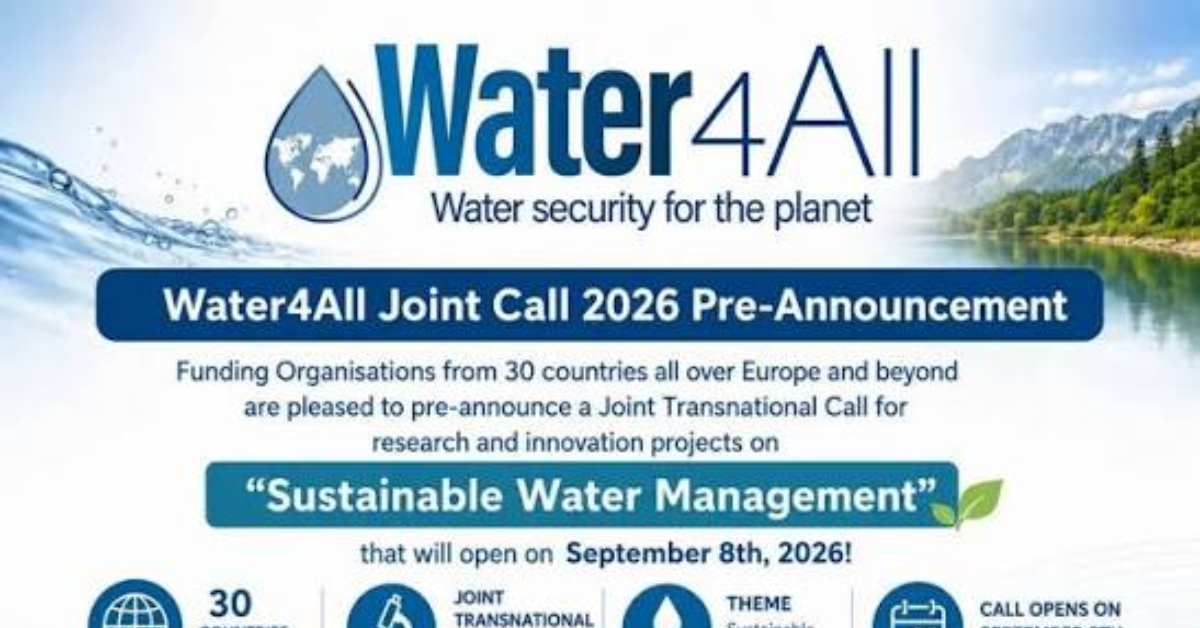
The Water4All Partnership – Water Security for the Planet has launched its 2026 Joint Transnational Call, creating a major international funding opportunity for collaborative research and innovation projects addressing Sustainable Water Management.
The call brings together 32 funding organisations from 30 countries across Europe and beyond and has an overall indicative budget of approximately €34 million.
Researchers, universities, research institutions and other eligible organisations can develop international consortia to investigate major challenges involving integrated water-resource management, river basins, groundwater, water resilience, monitoring and data management, and water-positive solutions.
The call officially opened on 8 September 2026.
Applicants must submit pre-proposals by 10 November 2026 at 15:00 CET. Successful consortia invited to the second stage will then have until 6 April 2027 at 15:00 CEST to submit full proposals.
Projects selected for funding are expected to begin around the end of 2027 or the beginning of 2028.
Water4All 2026 Joint Transnational Call: Key Details
Programme: Water4All 2026 Joint Transnational Call
Main Theme: Sustainable Water Management
Overall Indicative Budget: Approximately €34 million
Participating Funders: 32 funding organisations
Participating Countries: 30 countries across Europe and beyond
Funding Area: Research and Innovation
Call Opening: September 8, 2026
Pre-Proposal Deadline: November 10, 2026 at 15:00 CET
Pre-Proposal Selection: Early February 2027
Full Proposal Deadline: April 6, 2027 at 15:00 CEST
Final Selection: September 2027
Expected Project Start: End of 2027 / beginning of 2028
Kick-Off Meeting: Spring 2028
The call falls under Water4All’s Research and Innovation Development pillar and is scheduled to operate from September 2026 through the end of 2031.
About the Water4All 2026 Call
The 2026 Joint Transnational Call focuses on:
“Sustainable water management”
while explicitly excluding extreme events and circularity from the call’s central scope.
Water4All aims to support research and innovation capable of contributing to more sustainable and evidence-based water-management policies and practices.
The programme recognizes that water security is increasingly connected with environmental protection, sustainable development, public policy, technological innovation and effective management of natural resources.
The 2026 call therefore encourages international researchers and innovators to collaborate on solutions addressing critical water-management challenges.
Approximately €34 Million Available Across the Call
The Water4All 2026 Joint Transnational Call has an indicative overall budget of approximately:
€34 million.
This represents the total call-level budget rather than a guaranteed amount for any single project.
Applicants should therefore avoid interpreting the €34 million figure as an individual grant award.
The amount available to a particular consortium, institution or researcher may depend on the participating national or regional funding organisations and their respective rules.
This distinction is especially important when promoting the funding opportunity.
The accurate wording is that the joint call has an overall approximate budget of €34 million, not that individual applicants can necessarily receive €34 million.
32 Funding Organisations From 30 Countries
One of the strongest features of the Water4All call is its international structure.
A total of 32 funding organisations from 30 countries across Europe and beyond are participating.
This makes the programme particularly relevant for research teams seeking to build international partnerships around sustainable water management.
Rather than operating as a conventional single-country grant programme, Water4All uses a transnational model that brings together national and regional research funders.
Applicants must therefore pay close attention to both the general call requirements and any rules established by their relevant funding organisation.
What Research Does Water4All Want to Fund?
The call focuses on several major areas within sustainable water management.
These include:
Integrated Water Resource Management
Projects can investigate how water resources can be planned and managed more effectively across sectors, communities and environmental systems.
Integrated Water Resource Management, commonly known as IWRM, recognizes that water challenges cannot always be solved through isolated interventions.
Researchers may need to consider environmental, social, economic and institutional factors together.
River Basin Management
River basins often cross administrative and national boundaries.
Research in this area can contribute to better planning, governance, monitoring and management of shared water resources.
Groundwater Management
Groundwater is a critical source of water for households, agriculture, industry and ecosystems.
Research and innovation that improves understanding, monitoring and sustainable management of groundwater resources falls within the call’s broad focus.
Water Resilience
Projects may investigate ways of strengthening the resilience of water systems.
This can include research into how water-management systems can remain sustainable and effective under changing environmental, social or economic conditions.
Integrated Water Monitoring and Data Management
Reliable data is essential for effective water policy.
The call therefore recognizes the importance of integrated water monitoring and data management.
Research may contribute to improved monitoring systems, data integration, decision-support approaches or other evidence-based water-management tools.
Water-Positive Solutions
The call also includes water-positive solutions among its central challenge areas.
Research and innovation projects should aim to contribute to practical improvements in water management and long-term water security.
These focus areas are all identified in the official Water4All 2026 call.
Connection With International Water Policy
Water4All expects funded research to contribute to evidence-based water-management policies and strategies at different levels.
These can include global, European Union, and national frameworks.
The official call identifies several major policy frameworks, including the:
European Green Deal
Zero Pollution Action Plan
Water Framework Directive
Groundwater and surface-water quality directives
Just Transition Mechanism
European Water Resilience Strategy
Sustainable Development Goals
Applicants should therefore understand the policy relevance of their proposed research.
Projects should demonstrate awareness of the legislation and policy frameworks relevant to their research at national and international levels.
Strategic Research and Innovation Agenda
The broader context for the call is provided by Theme III of the Water4All Strategic Research and Innovation Agenda, titled:
“Integrated water management.”
Applicants developing proposals should therefore ensure their projects align with the wider strategic objectives of Water4All rather than addressing water-related research in a very general way.
A competitive proposal should establish a clear relationship between the research problem and sustainable water management.
International Collaboration Is Central
The call is specifically described as a Joint Transnational Call.
International collaboration is therefore fundamental to the programme.
Research teams considering an application should begin identifying suitable partners early.
Potential partners should bring complementary expertise rather than simply increasing the number of organizations involved.
For example, a consortium might combine expertise in:
Hydrology, environmental science, engineering, water governance, data science, economics and public policy.
The precise consortium structure and eligibility requirements should be checked against the official call documents and the rules of participating funding organisations.
Water4All Partner Search Tool
Water4All provides a dedicated partner search tool for applicants looking for collaborators or research projects.
This can be particularly useful for researchers who have a strong project idea but do not yet have all the international partners required for a competitive consortium.
Applicants can use the tool to identify potential collaborators and explore existing project ideas.
The official Water4All call page confirms that the partnering tool is available to researchers seeking either partners or projects.
International Information Webinar
Water4All will hold an international information webinar for the research community on:
September 17, 2026
from:
14:00–16:00 CEST.
The webinar will be presented in English.
It is intended to answer questions about the Joint Transnational Call and help prospective applicants understand the funding opportunity.
Water4All states that the webinar will be recorded and presentation slides will be made available the following week.
Why Researchers Should Attend the Webinar
For a complex transnational funding call, attending the information webinar can be particularly valuable.
Researchers can use it to better understand:
- The scope of the call
- Application procedures
- Consortium expectations
- Important deadlines
- Funding rules
- Common eligibility questions
Applicants who cannot attend live should look for the recording and presentation slides afterward.
The webinar may also help teams avoid spending significant time developing a proposal that falls outside the programme’s scope.
Two-Stage Application Process
The Water4All 2026 Joint Transnational Call uses a two-stage application process.
Stage One: Pre-Proposal
The call opened on:
September 8, 2026.
The deadline for submitting pre-proposals is:
November 10, 2026 at 15:00 CET.
Water4All expects the selection of pre-proposals to take place in:
Early February 2027.
Only projects progressing through the first stage would move forward to the full-proposal stage.
Stage Two: Full Proposal
The deadline for full proposals is:
April 6, 2027 at 15:00 CEST.
The selection of funded proposals is expected in:
September 2027.
Projects are then expected to begin around:
The end of 2027 or beginning of 2028.
A kick-off meeting for funded projects is expected in spring 2028.
Who Can Apply?
Because this is a transnational programme involving multiple funding organisations, applicants should not rely on a single universal eligibility assumption.
Eligibility may depend on the country, institution type and funding organisation involved.
Prospective applicants should therefore consult the official call documents and their relevant national or regional funder’s requirements before joining or coordinating a consortium.
This is particularly important for:
Universities
Research institutions
Public research organizations
Private-sector research and innovation organizations
Other potential consortium participants
The supplied call page confirms that specific eligibility criteria and additional modalities for Early Career Researchers form part of the official call documentation.
Early Career Researchers
Water4All specifically identifies additional modalities for Early Career Researchers within its call information.
Early-career applicants should therefore examine these provisions carefully rather than assuming the same rules apply to every applicant.
Researchers at earlier stages of their careers may also benefit from participating in international consortia led by more experienced investigators while bringing specialized expertise to the project.
The exact conditions should be verified from the detailed 2026 call documents.
Opportunity for Researchers Beyond Europe
The programme is not described as exclusively European.
Water4All states that participating funding organisations come from countries across Europe and beyond.
However, this does not mean that every researcher or institution in every country is automatically eligible for direct funding.
Funding eligibility generally needs to be assessed according to the participating organisations and applicable national requirements.
Researchers outside participating funding systems should therefore verify whether they can:
Receive direct funding, participate through another mechanism, or join a consortium under specific conditions.
This check should happen before significant resources are invested in preparing the proposal.
How to Build a Strong Consortium
A strong transnational consortium should be built around the research problem rather than around the largest possible number of partners.
Teams should consider whether each partner contributes distinct expertise.
For example, an interdisciplinary sustainable-water project could combine:
Water science
to understand hydrological systems.
Engineering
to develop or test technical solutions.
Data science
to analyze monitoring information.
Social sciences
to understand human behaviour and institutions.
Economics
to assess incentives, costs and resource allocation.
Policy expertise
to connect findings with water-management decisions.
The final consortium should still comply with the official Water4All rules.
How to Strengthen a Water4All Proposal
A competitive proposal should clearly identify a water-management challenge and explain why international collaboration is necessary.
Researchers should consider five major questions.
What problem are you solving?
Define the sustainable water-management challenge precisely.
Why does it matter?
Explain its environmental, social, scientific or policy significance.
Why is existing knowledge insufficient?
Identify the research or innovation gap.
Why is international collaboration necessary?
Show how participating countries and institutions provide complementary knowledge, datasets, environments or expertise.
What impact could the project achieve?
Explain how results could contribute to evidence-based water management.
Strong proposals should also show awareness of relevant policy and legislative frameworks.
Research Impact Matters
Water4All is not simply seeking academic research disconnected from implementation.
The call expects results to contribute to evidence-based water-management policies and strategies.
Applicants should therefore think about impact from the beginning of project development.
Potential pathways to impact might involve:
Policy recommendations, decision-support tools, improved monitoring approaches, datasets, management frameworks, technological innovations or practical guidance.
The precise output should follow from the research problem rather than being added artificially to satisfy funding language.
Avoid These Common Application Mistakes
Applicants should avoid treating this as a conventional individual research grant.
It is an international, transnational funding call.
Researchers should also avoid:
- Assuming the €34 million budget is available to one project
- Ignoring national funding rules
- Waiting until the deadline to identify international partners
- Proposing work outside sustainable water management
- Failing to explain policy relevance
- Ignoring the exclusions relating to extreme events and circularity
- Submitting without checking consortium eligibility
Careful preparation is particularly important because a consortium may involve organizations operating under different national funding rules.
Important Contact Information
The Water4All 2026 Call Secretariat is coordinated through the Project Management Agency Karlsruhe.
The official page identifies Anne Petzold and Simon Frank as contacts for the 2026 Joint Transnational Call.
Applicants with technical questions should use the official call contact details supplied by Water4All rather than relying solely on third-party opportunity websites.
Application Timeline at a Glance
The most important dates are:
September 8, 2026: Call opens
September 17, 2026: International information webinar
November 10, 2026 at 15:00 CET: Pre-proposal deadline
Early February 2027: Pre-proposal selection
April 6, 2027 at 15:00 CEST: Full-proposal deadline
September 2027: Selection of funded projects
End 2027 / beginning 2028: Projects expected to begin
Spring 2028: Kick-off meeting for funded projects.
Final Thoughts
The Water4All Sustainable Water Management Joint Call 2026 represents a significant funding opportunity for researchers and innovators seeking to address major water-management challenges through international collaboration.
With approximately €34 million in overall funding and 32 funding organisations from 30 countries, the programme brings together research funders across Europe and beyond.
The call focuses on Integrated Water Resource Management, River Basin Management, Groundwater Management, Water Resilience, Integrated Water Monitoring and Data Management, and Water-Positive Solutions.
Prospective applicants should begin building their consortium early, verify national eligibility requirements, and ensure their proposed research fits the call’s sustainable water-management focus.
The first major application deadline is November 10, 2026 at 15:00 CET for pre-proposals. Successful applicants will progress to the full-proposal stage, with submissions due April 6, 2027 at 15:00 CEST.
Researchers who are still searching for collaborators can also make use of Water4All’s dedicated partner-search facility.
SEO Keywords: Water4All 2026 Joint Transnational Call, Water4All Sustainable Water Management 2026, Water4All Funding 2026, Sustainable Water Management Grants 2026, €34 Million Research Funding, Water Research Grants 2026, International Research Grants 2026, Research and Innovation Funding 2026, Water Security Research Funding, Water4All Partnership Funding, European Water Research Grants, EU Research Funding 2026, International Research Funding Opportunities, Water Management Research Grants, Integrated Water Resource Management Funding, IWRM Research Grants, River Basin Management Research, Groundwater Research Funding, Water Resilience Research Grants, Water Monitoring Research Funding, Water Data Management Research, Water Positive Solutions Funding, Environmental Research Grants 2026, Sustainability Research Funding 2026, International University Research Grants, Research Consortium Funding 2026, Transnational Research Grants, Joint Transnational Call 2026, European Green Deal Research Funding, SDG 6 Research Funding, Water Innovation Grants 2026, Early Career Researcher Funding 2026, International Research Collaboration Grants, Water4All Call Deadline 2026, November 2026 Research Grants, Research Funding Europe 2026, Global Water Research Opportunities
Also Check
IOC Olympic Studies Centre Research Grant 2027: Up to USD 6,000 for PhD Students & Early Career Academics
Work Remotely on Africa’s Industrial Future: DSI/NRF SARChI Offers Up to $15,000 for 3 Research Commissions in 2026 (Fully Funded)
PILnet Is Hiring a Program Consultant (East Africa) | Remote NGO Consultancy | USD 1,300–1,600/Month
Follow Us On Our Social Media Platforms
WhatsApp Group:
https://chat.whatsapp.com/CculATjfuTNKDISQGtP0uw?s=cl&p=a&mlu=4&ilr=4
WhatsApp Channel:
https://whatsapp.com/channel/0029Vb7isAg6buMKEWUmte0K
Facebook Page:
